Best Business Bank Account Bonuses: How to Earn $400–$1,200 in 2026
If you own a business — even a small side hustle with an LLC or sole proprietorship — business bank account bonuses are one of the easiest ways to earn a few hundred to over a thousand dollars — honestly, one of the most reliable money moves I’d recommend. They tend to pay more than personal checking bonuses because banks value business relationships, and the requirements are often straightforward. Here’s how to approach them in 2026.
Why business bonuses are bigger
Banks compete hard for business customers, so business checking promotions routinely pay $400 to $1,200 or more — well above typical personal account bonuses. In 2026, examples have included offers in the $400–$500 range from Chase Business Complete Checking (for depositing and maintaining new money) and larger promotions from U.S. Bank’s business checking accounts that reach into four figures for higher balance requirements.
Offers change frequently and vary by region and promo code, so always confirm the current terms on the bank’s site before opening.
How the requirements usually work
Business bonuses generally ask for one or more of the following:
- Deposit new money — often $2,000 to $25,000 depending on the bonus size — within a set window (commonly 30–60 days).
- Maintain that balance for a period (often 60 days) without dipping below the threshold.
- Sometimes complete qualifying activities like a number of debit transactions or accepting card payments.
The bigger the bonus, the bigger the balance you’ll usually need to park. A $400 bonus might need $2,000; a $1,200 bonus might need $25,000 held for a month.
Who can open a business account
You don’t need a big company. Many banks let you open business checking as a sole proprietor using your Social Security number or an EIN, which means freelancers, gig workers, and side-hustlers often qualify. An LLC isn’t always required — check each bank’s eligibility.
The two things people forget
These bonuses are taxable. Unlike credit card welcome bonuses (which the IRS treats as a rebate), bank bonuses are taxable interest income. The bank will issue a 1099-INT, so factor that in — a $1,000 bonus in the 24% bracket nets about $760.
Watch the clawback. Banks require you to keep the account open for a minimum period (often 90–180 days). Close it too early and they can take the bonus back. Plan to leave it open past the clawback window.
The smart approach
- Confirm the current offer and promo code on the bank’s site before applying.
- Make sure you can meet the balance requirement comfortably before committing.
- Set calendar reminders for the deposit deadline, the maintenance period, and when it’s safe to close.
- Track the 1099-INT for tax time.
Bottom Line
Business bank account bonuses are an underrated way to earn $400–$1,200+, often more than personal accounts pay, and freelancers or side-hustlers with just an SSN or EIN frequently qualify. Read the current terms carefully — deposit amount, maintenance period, and clawback window — and remember these bonuses are taxable income (you’ll get a 1099-INT), so plan around the deadlines and keep the account open long enough to keep the cash.
How this works in practice
Say you run a small consulting business as a sole proprietor. You have been keeping your business revenue in your personal checking account, which earns nothing beyond the base interest. A bank is currently offering a $500 bonus for new business checking customers who deposit $5,000 in new money and maintain it for 60 days, plus complete 5 qualifying debit card transactions.
You open the account with $5,000 you have been holding in a low-interest savings account. Over the next 60 days, you make six small business purchases on the debit card — office supplies, a software subscription, a parking charge. On day 61, the $500 posts to your account.
After the clawback window passes (say 90 days after the bonus), you move the $5,000 back to a higher-yield account. You have earned $500 for roughly 10 minutes of setup and keeping money in a different bank for three months. In the 24% tax bracket, the after-tax value is about $380 — still a strong return on deposited capital.
The key was reading the fine print up front: the specific transaction type that qualifies, the exact balance requirement, and the clawback window. Missing any of those details is the most common reason people put in the work and still lose the bonus.
Pros and cons of business bank bonuses
Pros
- Business bonuses consistently pay more than personal checking bonuses — often $400 to $1,200 or more for straightforward requirements.
- The requirements are usually achievable: deposit money, do a few transactions, wait. Most business owners can do this without changing their banking behavior meaningfully.
- Qualifying is often easier than people assume — sole proprietors and freelancers typically qualify with just an SSN or EIN, no formal corporation required.
- Stacking is possible: if you are eligible at multiple banks, you can work through several offers in a year, earning several hundred to over a thousand dollars.
Cons
- The bonus is taxable income, reported on a 1099-INT. A $1,000 bonus in the 24% bracket leaves you with about $760 after federal taxes.
- Money is tied up for the holding and clawback period — often 3–6 months total — during which it cannot easily be moved.
- Some offers require a minimum monthly average balance to waive fees, and if you fall below it, monthly fees can eat into the bonus.
- Offers change frequently and are often region-specific or promo-code-gated, requiring research before each opening.
Business bank bonuses vs. personal checking bonuses: a comparison
Both types of bank bonuses follow similar structures — deposit money, meet requirements, collect bonus — but there are meaningful differences.
Bonus size: Business bonuses typically pay more. Personal checking bonuses often range from $100 to $400; business bonuses can reach $1,200 or beyond for the right balance tier.
Requirements: Personal checking bonuses often require direct deposits (routing your paycheck), which limits flexibility. Business bonuses are more likely to require a balance hold and a modest number of debit transactions — requirements that are often simpler for small business owners to meet.
Eligibility: Personal accounts are available to anyone. Business accounts require at least some business activity — even informal freelance work counts — plus an EIN or SSN filed with the bank as a sole proprietor.
Verdict: If you have any legitimate business income, opening a business account for the bonus is almost always worth doing before or alongside a personal checking bonus, because the payoff is larger for similar effort.
Frequently asked questions
What counts as a “business” to open a business bank account?
Far less than most people think. Freelancers, gig workers (Uber, Etsy sellers, Upwork contractors), independent contractors, and anyone with self-employment income typically qualify. You do not need an LLC, a formal business plan, or employees. Many banks allow sole proprietors to open business accounts with just their Social Security number as the business ID, though having an EIN (free from the IRS) often makes the process smoother.
Can I open a business checking account just for the bonus and then close it?
Yes, but timing matters. Most banks have a clawback window — commonly 90–180 days after the bonus posts — during which closing the account triggers a reversal of the bonus. Wait until that window passes before closing. Factor the clawback period into your planning so you are not caught off guard.
How do I find current business bank bonus offers?
The most reliable aggregators are Doctor of Credit (doctorofcredit.com) and NerdWallet, both of which maintain actively updated lists with the current bonus amounts, promo codes, and requirements. Always verify the offer terms directly on the bank’s website before applying, since bonus amounts and eligibility can change without notice on aggregator sites.
How many business account bonuses can I earn per year?
There is no universal limit, but each bank generally allows one bonus per business entity per offer period. If you have multiple business entities (an LLC and a sole proprietorship, for example), you may qualify separately at some banks. In practice, working through two to four offers per year is common among active bank bonus chasers, limited mainly by available cash to meet the balance requirements.
Will opening multiple business accounts hurt my credit score?
Business bank accounts typically involve only a soft credit pull or no pull at all — unlike credit card applications, which trigger hard inquiries. Opening several business checking accounts in a year generally does not impact your personal credit score. Some banks may do a hard pull for certain accounts; confirm before applying if this matters to you.
Keep reading
- Business Bonuses
Novo Business Checking Review: Free Banking for Founders and Side Hustles
Novo offers no-fee business checking with invoicing, budgeting Reserves, and faster Stripe payouts. Here's how it works and who should use it.
- Credit for Immigrants
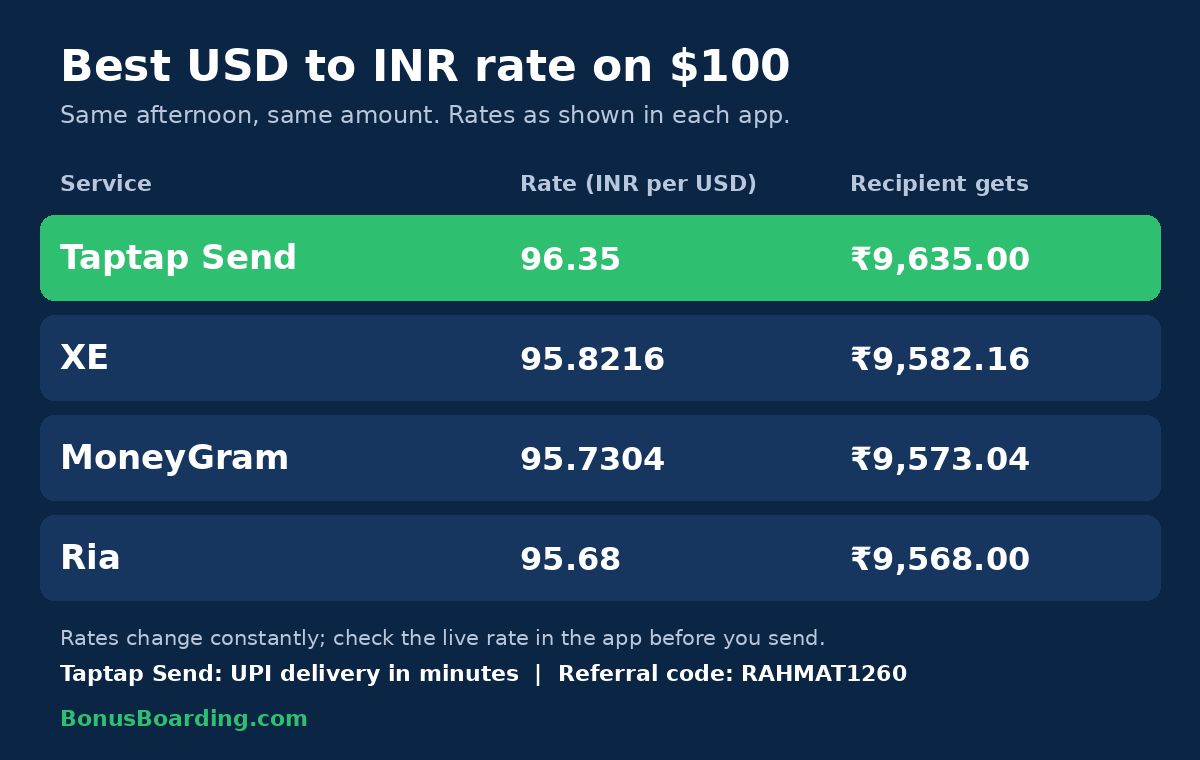
Taptap Send Review: Best USD to INR Rate Compared
What Taptap Send is, how US-to-India transfers work, and how its USD to INR rate compared with XE, MoneyGram and Ria on the same afternoon.
- Build Credit
How to Build US Credit From Zero: Secured Cards, Loans, and Quick Wins
No SSN? Thin file? Here's the honest, step-by-step roadmap to building US credit fast — with real numbers and card picks for newcomers.
Join the discussion
Share your take, ask a question, or swap tips with other readers. Be kind — we moderate.