How to Find the Best Bank Account Bonus Offers

Banks spend heavily to win new customers, and a lot of that money flows straight to people who open accounts strategically. Honestly, I’d do this for any new account regardless — bank bonuses range from a couple hundred dollars to $3,000 or more for the biggest offers. The trick is knowing where to find current promotions and how to judge which ones are actually worth your effort. Here’s how.
Where to find current bank bonuses
Because offers change constantly and vary by region, rely on continuously updated trackers rather than memory:
- Doctor of Credit maintains the most comprehensive running list of current bank bonuses, including the fine print and data points from real users.
- NerdWallet and similar sites publish curated monthly roundups of the best offers.
- The banks’ own sites — sometimes a promo code or a specific landing page unlocks a higher bonus than the default.
Check these before opening any account; a little searching can turn a $200 bonus into a $500 one.
How to judge whether a bonus is worth it
Not every bonus is worth chasing. Weigh these factors:
- Effort vs. reward. A $300 bonus that needs a single direct deposit is easy money. A $300 bonus that requires holding $25,000 for six months may tie up cash you could earn more on elsewhere.
- Can you meet the requirement? Most need either qualifying direct deposits or a minimum balance held for a period. Be honest about whether you can.
- The opportunity cost of locked-up money. If a bonus requires parking a big balance, compare the bonus to the interest you’d earn keeping that money in a high-yield savings account.
- Taxes. Bank bonuses are taxable (you’ll get a 1099-INT), unlike credit card bonuses — factor that into the real payout.
A simple system for bank bonuses
- Pick offers that match your situation — direct-deposit bonuses if you have a paycheck to route, balance bonuses if you have a lump sum to park.
- Read the terms for new-customer rules, deadlines, and the clawback period.
- Set reminders for the requirement deadline and when it’s safe to close.
- Don’t over-apply at once — opening too many accounts quickly can trip fraud flags or hurt your banking history with some institutions.
Bottom Line
Bank bonuses are real money — $200 to $3,000+ — and the best way to find them is through running trackers like Doctor of Credit and NerdWallet plus the banks’ own promo pages. Judge each offer on effort versus reward, whether you can meet the direct-deposit or balance requirement, the opportunity cost of locked-up cash, and the fact that bonuses are taxable. Pick the ones that fit your situation, mind the deadlines and clawback, and the cash adds up.
How this works in practice
Here is a realistic example of a bank bonus done well:
A teacher has $8,000 sitting in a low-yield savings account that she does not need immediate access to. She checks Doctor of Credit and finds a checking account bonus at a major bank: $400 for new customers who receive two qualifying direct deposits of at least $500 each within 90 days. She can route her paycheck to the new account for two pay periods — about six weeks — then switch it back if she prefers.
She opens the account online in 10 minutes, routes two paychecks, confirms the bonus posts (which the bank’s terms say takes up to 30 days after qualifying), then moves her direct deposit back to her primary bank. Total time invested: maybe two hours spread over two months. Total earned: $400 minus the ~$40 she would owe in taxes at her marginal rate, for a real payout of about $360.
Compare that to leaving $8,000 in a 0.5% savings account for the same two months: about $6.67 in interest. The bonus was 54 times more productive on the same capital.
This is the core of bank bonus math: the offer is front-loaded and predictable, unlike interest which compounds slowly. The effort is the limiting factor, not the money.
Types of bank bonus requirements
Bank bonuses generally fall into a few requirement categories. Understanding which type a bonus uses tells you whether it fits your situation:
Direct deposit bonuses — The most common type. The bank requires one or more direct deposits above a minimum threshold (often $500–$1,500 per deposit) within a set window. Many banks accept payroll ACH, government benefits, and sometimes even external ACH transfers labeled as “direct deposit” — but definitions vary. Read the fine print, and check the Doctor of Credit comments section for data points from other users about what the specific bank accepts as qualifying.
Minimum balance bonuses — You deposit and hold a specified amount for a period (typically 60–90 days). These require more capital tied up but less active management. The opportunity cost calculation matters here — if a $10,000 hold earns you $300 but that $10,000 would have earned $400 in a high-yield savings account over the same period, the bonus is only worth $300 minus the interest foregone.
Spending bonuses — Some checking accounts require a number of debit card transactions within the window. These are generally easy to meet with small everyday purchases but add a tracking requirement.
Combined bonuses — A large bonus may require both a minimum direct deposit and a minimum daily balance. These are more lucrative but more demanding.
The opportunity cost calculation
The opportunity cost of a bank bonus is the most commonly ignored part of the math — and the one that turns a mediocre bonus into a bad deal:
Say a bonus requires holding $25,000 for 90 days to earn $300. A competitive high-yield savings account paying 4.5% annually would earn roughly $280 on that same $25,000 in 90 days. The bonus net of opportunity cost is only $20 — for what might be significant effort.
Run this calculation on every balance-requirement bonus. The breakeven formula: effective bonus rate = bonus amount / (balance held × hold period in years). If that rate is not meaningfully above what you could earn elsewhere with no effort, skip the bonus.
Pros and cons of pursuing bank bonuses
Pros
- Cash payouts, not points — straightforward value with no redemption complexity
- Larger bonuses can rival credit card welcome bonuses in dollar terms
- The process is repeatable; you can pursue multiple bonuses over time as new-customer clocks reset
- Diversifies income from rewards beyond credit card spending
Cons
- Bonuses are taxable (unlike credit card rewards) — you will receive a 1099-INT
- Tracking multiple accounts, requirements, and deadlines adds administrative overhead
- Some banks have clawback provisions — they take the bonus back if you close within 6–12 months
- Aggressively opening many bank accounts can show up in ChexSystems and complicate future banking relationships
- Direct-deposit workarounds may stop working as banks tighten their definitions
Frequently asked questions
Are bank bonuses legal and legitimate?
Yes, completely. Banks advertise these offers publicly as a customer acquisition strategy. The IRS taxes them as income, and the bank reports them with a 1099-INT — which is simply the correct treatment for cash income, not a red flag.
How many bank bonuses can I pursue at once?
There is no hard limit, but practical limits exist. Tracking deadlines, direct deposit routing, and clawback periods across more than 3–4 accounts simultaneously becomes error-prone. Most people who do this systematically work through one or two bonuses at a time, close or settle accounts before moving to the next round.
Does opening a bank account hurt my credit score?
Usually no — most bank account openings do not trigger a hard inquiry on your credit report. Banks often check ChexSystems (a banking-specific report) instead. However, some banks do pull a hard inquiry; the offer terms or a pre-application call can clarify this.
What is the clawback period?
Most bank bonuses require you to keep the account open for a minimum period after the bonus posts — commonly 6–12 months. If you close early, the bank deducts the bonus amount from your final balance. Always note the clawback end date and set a calendar reminder so you do not close accidentally.
Can I get a bank bonus if I was previously a customer?
Most offers specify “new customers” or “accounts not opened in the past 12–24 months.” If you have banked there before, check the fine print. Some banks track previous customer status indefinitely; others have a fixed lookback window after which you qualify again.
Comparing bank bonuses to high-yield savings: when each wins
Bank bonuses and high-yield savings accounts are not mutually exclusive — they serve different purposes and can be combined. A high-yield savings account delivers predictable, ongoing interest with zero effort. A bank bonus delivers a front-loaded, one-time cash payout that typically exceeds what the same money would earn in interest over the bonus period.
The practical choice: keep your core emergency fund in a high-yield savings account where it earns competitive interest with no strings attached. Pursue bank bonuses with money you can afford to route differently for 60–90 days — a portion of your savings above your emergency fund threshold, or cash you were holding short-term for a known expense. Do not sacrifice your emergency fund’s accessibility or your primary banking relationship for a bonus.
Related reading
Keep reading
- Bank Offers
Country Bank $500 Business Bonus Is Springfield-Only
Country Bank's $500 business checking bonus is not a New England-wide deal. It requires Springfield Banking Center opening and eligible ZIPs.
- Credit for Immigrants
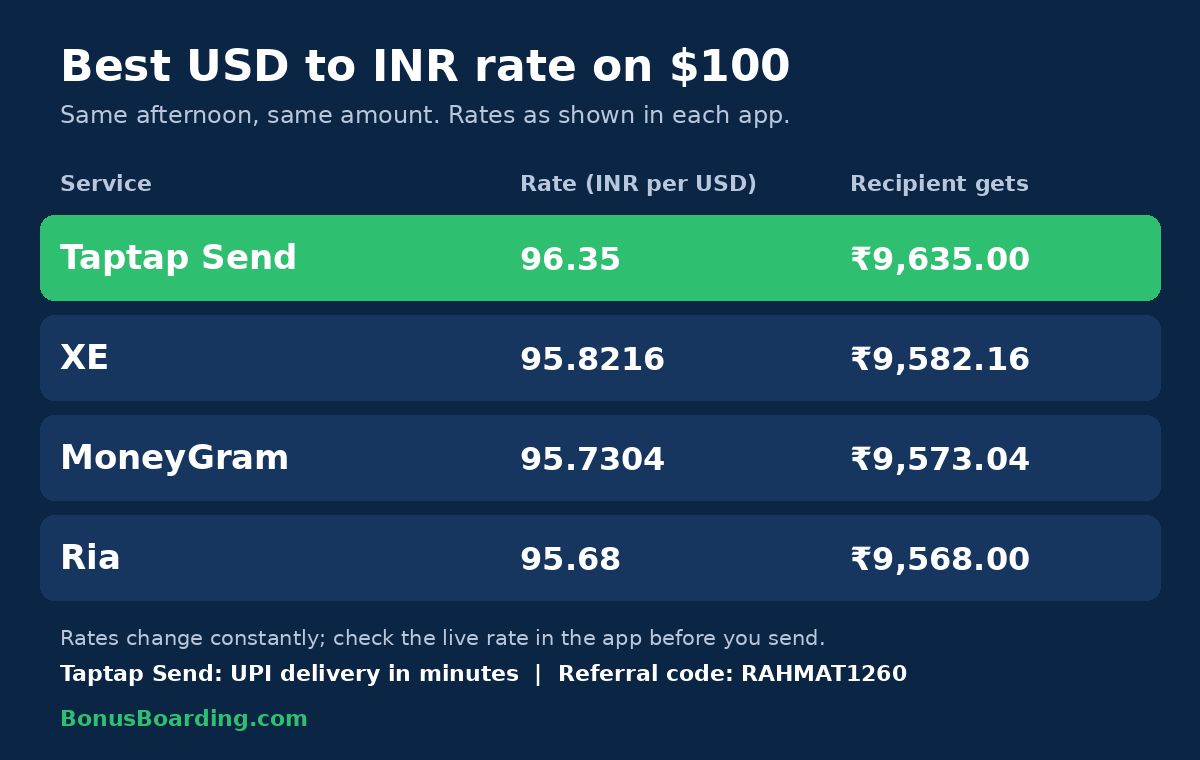
Taptap Send Review: Best USD to INR Rate Compared
What Taptap Send is, how US-to-India transfers work, and how its USD to INR rate compared with XE, MoneyGram and Ria on the same afternoon.
- Build Credit
How to Build US Credit From Zero: Secured Cards, Loans, and Quick Wins
No SSN? Thin file? Here's the honest, step-by-step roadmap to building US credit fast — with real numbers and card picks for newcomers.

Join the discussion
Share your take, ask a question, or swap tips with other readers. Be kind — we moderate.