Bilt Rewards: A Beginner's Guide to Earning Points on Rent
For most people, rent is the single biggest monthly expense — and until Bilt Rewards came along, it earned you nothing. Bilt’s whole pitch is letting you earn transferable points on rent with no transaction fee, then move those points to airline and hotel partners like any premium currency. For renters who were earning nothing on rent before, it’s close to free money. Here’s how it works — and why I think it’s worth keeping this card even if you move somewhere rent is lower.
The core idea: points on rent
With the Bilt Mastercard apply →, you can pay your rent — even to landlords who don’t accept credit cards — and earn points on it, without the 2–3% processing fee that normally makes paying rent by card a losing proposition. That’s the unique hook: a huge recurring expense that earned nothing now builds a stash of valuable, transferable points every month.
You also earn on dining, travel, and other everyday spending, and there’s a quirk worth knowing: Bilt requires you to make at least five transactions per statement for your points to post, so use the card a few times beyond rent each month.
Rent Day — the monthly bonus
On the first of every month (“Rent Day”), Bilt runs bonus earning and special promotions — doubled points on non-rent spending and periodic transfer bonuses to partners. Savvy Bilt users time bigger purchases and point transfers around Rent Day to squeeze out extra value.
The transfer partners
Bilt’s value, like Chase and Amex, comes from 1:1 transfers to airline and hotel partners. Its lineup is strong and growing, including Alaska’s Atmos Rewards, World of Hyatt, Air France-KLM Flying Blue, Avianca LifeMiles, Turkish Airlines, United (via a unique arrangement), and more — with Etihad Guest among recent additions. The Hyatt and Alaska/Atmos partnerships in particular make Bilt genuinely useful for high-value redemptions, not just a rent gimmick.
What the points are worth
Bilt points carry the same upside as other transferable currencies — commonly around 2 cents each when transferred to the right partner for a premium redemption. But the real story is the source: you’re earning these valuable points on money you were going to spend on rent anyway, which makes the effective return exceptional for renters.
The smartest ways to use Bilt
- Pay rent with the Bilt card to earn on your biggest expense fee-free — the core reason the program exists.
- Hit five transactions a month so your points actually post.
- Transfer to Hyatt or Alaska/Atmos for the best-value redemptions.
- Time transfers and big spending around Rent Day to capture bonuses.
Bottom Line
Bilt Rewards is a must-know for renters: it’s the only program that earns valuable, transferable points on rent with no fee, then lets you move them 1:1 to strong partners like Hyatt, Alaska’s Atmos Rewards, and Flying Blue. Pay rent with the card, remember the five-transactions-a-month rule, lean on Rent Day promotions, and you’ll turn your single biggest bill into premium travel.
Part of our complete Points & Miles guide. Not sure what your points are worth? See the latest points valuations or run the numbers with our free calculators.
How this works in practice
Say Alex pays $1,800 a month in rent. With a standard credit card, a payment processor would charge a 2–3% fee to accept the payment — costing $36–$54 a month, or $432–$648 a year. That fee makes paying rent by card a clear loser financially.
With the Bilt Mastercard, Alex pays rent fee-free and earns 1 point per dollar on rent. That is 1,800 Bilt points every month, or 21,600 points over a year. He also makes five small purchases a month on the card (a coffee run, groceries, a gas fill-up) to meet the minimum transaction requirement, earning a few hundred more points.
At the end of the year, Alex has roughly 23,000 Bilt points. He transfers them to World of Hyatt at 1:1 and books one and a half nights at a Hyatt hotel that would have cost $300+ per night in cash.
He paid for those hotel nights with money he was spending on rent anyway — the only “cost” was meeting the 5-transaction monthly minimum. That is as close to free travel as any rewards card offers.
Pros and cons of Bilt Rewards
Pros
- Turns rent — typically the largest monthly expense, and previously unrewarded — into valuable transferable points.
- No transaction fee on rent payments, which is the unique and non-negotiable feature. Every other method of paying rent by card incurs a fee that erases the value.
- Strong transfer partner lineup, including World of Hyatt, Alaska’s Atmos Rewards, and Air France-KLM Flying Blue.
- The Bilt card has no annual fee, so every point earned is pure gain with no fee to offset.
- Rent Day on the first of each month provides bonus earning and periodic transfer bonuses, a recurring opportunity to stack value.
Cons
- The five-transactions-per-statement rule is easy to forget, and missing it means zero points for the month — not a reduced amount, zero. You have to actively remember to use the card at least five times.
- Rent earning is capped at 1x — you earn 1 point per dollar on rent, not a higher category rate. The card is competitive but not exceptional on non-rent spending.
- Bilt is a newer program and, while growing quickly, has a shorter track record than Chase or Amex — program rules and partner relationships could change.
- The card has no welcome bonus, which is unusual among rewards cards and means there is no upfront burst of points when you open it.
Bilt Rewards vs. Chase Ultimate Rewards for renters
If you rent and are deciding whether to prioritize Bilt or Chase, here is the honest comparison:
Bilt’s unique advantage: Earning on rent fee-free is something no Chase card can do. If rent is your biggest expense, Bilt earns points on dollars that Chase simply cannot touch.
Chase’s advantages: A larger and more established ecosystem, the Hyatt transfer (which Bilt also has), the 5/24 rule to navigate strategically, and strong earning across more spending categories including dining, travel, and rotating categories on Freedom cards.
The best-case scenario for renters: Hold both. Use the Bilt card exclusively for rent and dining (where it earns 3x). Use a Chase Freedom Unlimited or Sapphire Preferred for other spending. Transfer Bilt points to Hyatt and Chase points to Hyatt separately — both feed the same account.
These programs are complementary, not competitive. Most renters with a points strategy end up holding a Bilt card alongside a Chase card, not choosing between them.
Frequently asked questions
Does my landlord need to accept credit cards for Bilt to work?
No. Bilt has relationships with many major rental properties and works through its own payment network even where landlords don’t directly accept cards. For landlords outside the Bilt network, Bilt can also facilitate payment via ACH in some cases. The fee-free arrangement applies through Bilt’s infrastructure regardless of whether your specific landlord “accepts” credit cards in the traditional sense.
What happens if I miss the five-transaction minimum one month?
You earn zero points for that statement period — including on rent. Bilt does not prorate or reduce the points; it is a binary outcome. To avoid this, set a calendar reminder on the 25th of each month to check your transaction count and make additional small purchases if you are short.
Can I earn Bilt points on rent if I own a home?
No. Bilt is explicitly designed for renters. If you own your home and pay a mortgage, that payment does not earn Bilt points. The program exists specifically to reward the renting population, which previously had no credit card rewards path for their largest monthly expense.
Are Bilt points transferable to the same partners as Chase?
There is meaningful overlap: both Bilt and Chase transfer to World of Hyatt, Air France-KLM Flying Blue, and United (Bilt via a unique arrangement). Bilt’s exclusive partners include Alaska’s Atmos Rewards and Avianca LifeMiles. Chase has British Airways/Iberia Avios, Southwest, JetBlue, and others that Bilt does not. They are complementary, covering slightly different partner sets.
Is there a minimum transfer amount for Bilt points?
Bilt requires a minimum of 2,000 points per transfer, and transfers must be in 1,000-point increments above that. Transfers are generally instant to most partners.
Keep reading
- Credit for Immigrants
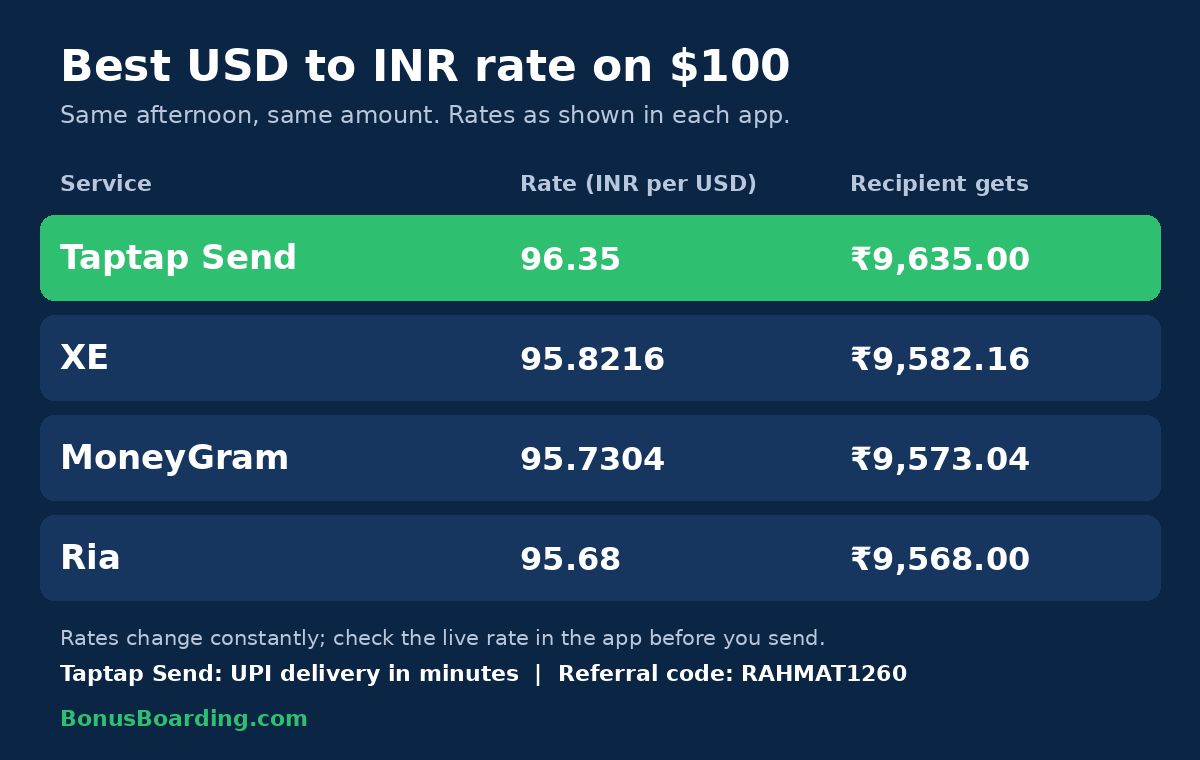
Taptap Send Review: Best USD to INR Rate Compared
What Taptap Send is, how US-to-India transfers work, and how its USD to INR rate compared with XE, MoneyGram and Ria on the same afternoon.
- Build Credit
How to Build US Credit From Zero: Secured Cards, Loans, and Quick Wins
No SSN? Thin file? Here's the honest, step-by-step roadmap to building US credit fast — with real numbers and card picks for newcomers.
- Business Cards
How to Build US Business Credit as a Newcomer: First Steps
No SSN? No credit history? Here's exactly how H-1B workers, F-1 students, and new immigrants start building US business credit from zero.
Join the discussion
Share your take, ask a question, or swap tips with other readers. Be kind — we moderate.