Transfer Bonuses: How to Make Your Points Go 20–40% Further
Once you understand transfer partners, the next lever is the transfer bonus — a limited-time promotion that gives you extra miles when you move your points to a specific partner. I’d make checking for these a habit before any transfer. Used well, a transfer bonus is free value layered on top of an already-good redemption.
What a transfer bonus is
Normally, transferable points (Chase, Amex, Capital One, Citi, Bilt apply →) move to airline and hotel partners at 1:1. During a transfer bonus, the bank temporarily sweetens the ratio. A common promo is a 20% to 40% bonus: with a 30% bonus, transferring 10,000 points gets you 13,000 miles in the partner program instead of 10,000.
These promotions rotate constantly. Amex, Capital One, and Citi run them frequently — Capital One alone averages roughly six to eight transfer bonuses a year. They typically last a few weeks and apply to one or two partners at a time.
Why they’re so valuable
A transfer bonus stacks directly on top of the transfer-partner value you’re already capturing. If a business class award is a good deal at 60,000 miles, a 30% transfer bonus means you only need to move about 46,000 points to get those 60,000 miles. You’ve cut the cost of an already-strong redemption by nearly a quarter — for doing nothing but timing the transfer right.
How to use them the smart way
- Still confirm the award first. A transfer bonus doesn’t change the golden rule: find the available flight or hotel award before you transfer. A bonus on points you can’t use is worthless.
- Don’t let the bonus tempt you into a bad redemption. Transferring during a 30% bonus to a program where you have no plans just leaves your points stuck. The bonus only matters if you’ll actually use the miles.
- Know your target partners. If you frequently book Virgin Atlantic, Air France-KLM Flying Blue, or Avios-based programs (British Airways, Iberia, Qatar), watch for bonuses to those — they come around regularly.
- Track the promotions. Sites like FrequentMiler and NerdWallet maintain running lists of current transfer bonuses across all the banks. Check before any large transfer.
- Transfer in the right increments. Move only what you need for your redemption (plus a small buffer), since transfers are one-way and final.
A realistic example
Say you want a 50,000-mile award and your airline is running a 25% transfer bonus from Amex. Instead of transferring 50,000 Membership Rewards points, you transfer 40,000 and the bonus tops you up to 50,000. You just saved 10,000 points — which might be a third of a domestic round-trip — purely on timing.
Bottom Line
Transfer bonuses temporarily boost the rate at which your points convert to airline and hotel partners, usually by 20–40%, and they stack on top of an already-good transfer redemption. Watch running lists of current promotions, but never let a bonus push you into transferring points you can’t actually use — the rules still apply: confirm the award first, transfer only what you need, and remember it’s one-way and final.
Part of our complete Points & Miles guide. Not sure what your points are worth? See the latest points valuations or run the numbers with our free calculators.
How this works in practice
Say you want to book a round-trip business class flight from the US to Europe. The airline you want to use prices the award at 60,000 miles round-trip through a partner program. You have 50,000 Amex Membership Rewards points.
Normally, transferring 50,000 points would get you exactly 50,000 miles — not enough. You would need to earn another 10,000 points first, or find a different award.
But this week, Amex is running a 30% transfer bonus to that partner. Instead of needing 60,000 points to get 60,000 miles, the math flips: you transfer 46,200 points and the 30% bonus tops you up to the 60,100 miles you need. You are 3,800 points short of a round-trip business class award without the bonus — and comfortably over the threshold with it.
The flight you book would cost $4,000+ in cash. You paid for it with 46,200 points and a few hundred dollars in taxes and fees. The transfer bonus stretched your existing balance over the finish line without you earning a single additional point.
This is transfer bonus strategy at its best: the award was already confirmed available, the transfer completed in minutes, and the bonus eliminated a shortfall.
Pros and cons of transfer bonuses
Pros
- Pure free value: you are getting more miles for the same points you already have, at no additional cost.
- They come around regularly — Amex, Capital One, and Citi all run multiple transfer bonuses per year across their partner lists. Active points holders can capture several bonuses annually.
- A bonus can bridge a gap, as in the example above, turning a “not enough points” situation into a completed booking.
- They reward patience. If you are not in a rush to book, waiting for a bonus to a key partner can meaningfully lower the cost of a redemption.
Cons
- They can tempt you into bad decisions. Seeing a “30% bonus” and transferring points to a program where you have no imminent booking is how points get stranded — transfers are one-way and final.
- Bonuses are unpredictable. You cannot count on a specific partner having a bonus when you need to book. It is an opportunity to capture when it aligns, not a strategy to rely on.
- Award availability does not wait for bonuses. The seat you want may not be available by the time the right bonus comes around, so waiting for a bonus can cost you the booking.
- Not every program gets frequent bonuses. Chase rarely runs transfer bonuses; its value comes from the clean 1:1 ratio and Hyatt, not promos.
Transfer bonuses vs. earning bonuses: what is the difference?
It is worth distinguishing two types of promotions that sound similar:
An earning bonus gives you extra points when you spend on your credit card. For example: “Earn 5x on groceries this quarter instead of the usual 3x.” This happens at the point-earning stage.
A transfer bonus gives you extra miles when you move your existing points to a partner program. For example: “Transfer Amex points to Flying Blue and receive 30% more miles.” This happens at the redemption stage.
Both types of promotions add value, but they operate at different steps. Many savvy points collectors try to stack them: earning accelerated points during an earning bonus, then transferring those points during a transfer bonus — though the two rarely align perfectly for the same partner at the same time.
Frequently asked questions
How do I find out about current transfer bonuses?
The most reliable way is to check sites like FrequentMiler (frequentmiler.com) and NerdWallet, which maintain actively updated lists of current transfer bonuses across all major programs. You can also check Amex’s, Capital One’s, and Citi’s transfer pages directly, as bonuses appear there when active. The key is checking before you transfer, not after.
Do transfer bonuses apply retroactively if I transferred right before one started?
No. Transfer bonuses apply only to transfers made during the promotional period. There is no retroactive credit if you transferred one day before the bonus launched. This is an unfortunate but firm rule — another reason to check for bonuses before initiating any large transfer.
Can I take advantage of the same transfer bonus multiple times?
Generally yes, as long as you have additional points to transfer. A transfer bonus applies to each eligible transfer during the promotional period, not just one. If you transfer 20,000 points in week one and another 30,000 in week two during the same promotion, both transfers receive the bonus.
What programs run transfer bonuses most frequently?
Amex, Capital One, and Citi run transfer bonuses regularly — Capital One in particular has averaged a high volume of promotions in recent years. Chase rarely runs transfer bonuses, which is part of why its value proposition centers on the clean 1:1 ratio and the Hyatt partnership rather than promotional timing. Bilt runs Rent Day bonuses on the first of each month, which often include transfer promotions to select partners.
Is a 20% transfer bonus always worth waiting for?
It depends on your urgency and the award. For a large redemption — a business class award requiring 60,000+ miles — a 20–30% bonus can save tens of thousands of points, which is clearly worth a brief wait if award space is available. For a small domestic award at 15,000 miles, the bonus savings are modest and waiting could cost you the seat. Prioritize award availability over bonus optimization for time-sensitive bookings.
Keep reading
- Transfer Bonuses
Bilt's July Rent Day: Hilton Bonus — Why I'm Probably Passing
Bilt Rent Day sometimes features Hilton Honors transfer bonuses, but the math rarely favors locking in hotel points. Here's when it makes sense and when to hold.
- Credit for Immigrants
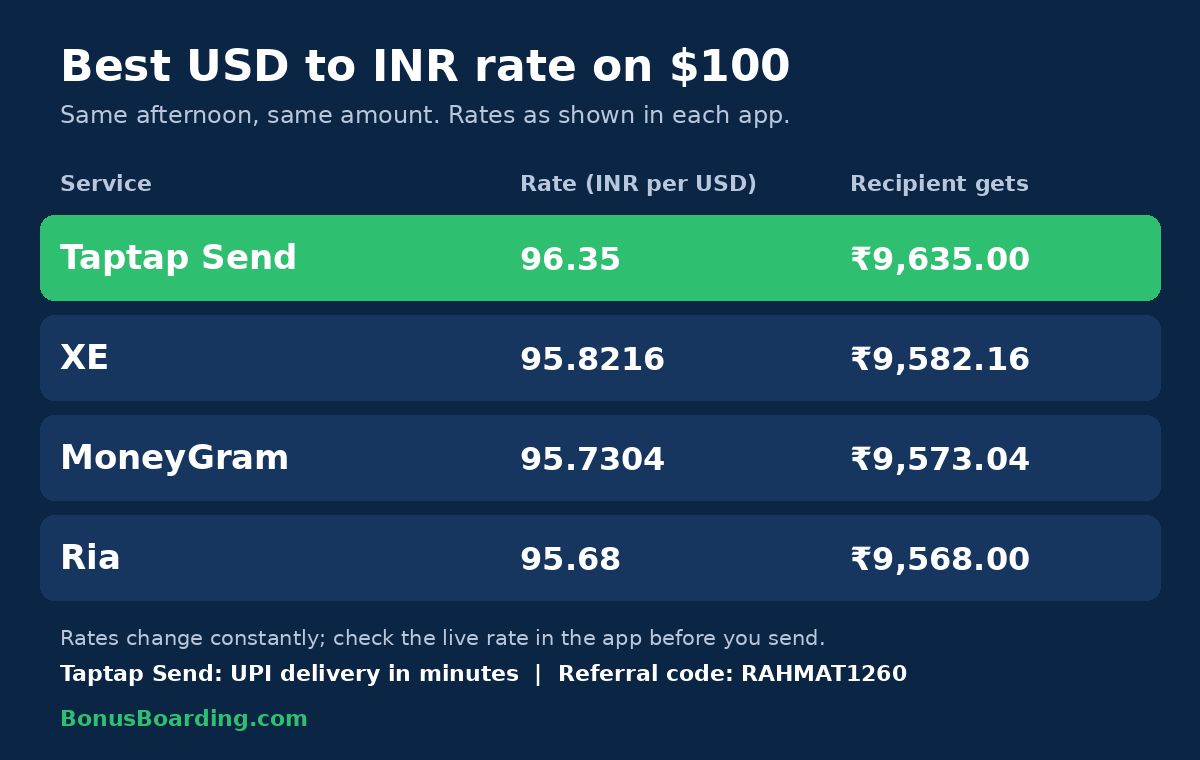
Taptap Send Review: Best USD to INR Rate Compared
What Taptap Send is, how US-to-India transfers work, and how its USD to INR rate compared with XE, MoneyGram and Ria on the same afternoon.
- Build Credit
How to Build US Credit From Zero: Secured Cards, Loans, and Quick Wins
No SSN? Thin file? Here's the honest, step-by-step roadmap to building US credit fast — with real numbers and card picks for newcomers.

Join the discussion
Share your take, ask a question, or swap tips with other readers. Be kind — we moderate.