Transfer Partners Explained: The Key to Getting Real Value From Points
If you only ever redeem your credit card points for cash back or through a bank’s travel portal, you’re leaving a lot of value on the table. I’d argue this is the single most important concept in the points-and-miles world is the transfer partner — and understanding it is what separates people who get 1 cent per point from people who get 2 cents or more.
What a transfer partner is
The major bank rewards currencies — Chase Ultimate Rewards, American Express Membership Rewards, Capital One miles, Citi ThankYou Points, and Bilt apply → Rewards — are called transferable points. That means you can move them directly into the loyalty programs of airlines and hotels that partner with the bank.
So instead of cashing in 50,000 Chase points for $500 in the travel portal, you could transfer those 50,000 points to World of Hyatt and book a hotel night that would have cost $800+ in cash. Same points, far more value — because you’ve moved them into a program where they buy more.
Why this creates value
Airline and hotel award charts often price premium redemptions far below their cash cost. A business class seat that sells for $4,000 might cost 60,000 airline miles. If you can transfer 60,000 bank points into that airline, you’ve turned points worth maybe $600 in cash into a $4,000 flight. That gap is the entire game.
This is why transferable points are more valuable than co-branded airline miles or fixed cash back: they’re flexible. You’re not locked into one airline — you transfer only when you’ve found a great redemption.
How transferring actually works
- You link your loyalty account (say, your United or Hyatt number) to your bank’s transfer page.
- Transfers are usually 1:1 — 1,000 bank points become 1,000 airline miles — though some partners have less favorable ratios (more on that below).
- Most transfers are instant, though some hotel and airline partners take a few hours.
- Transfers are one-way and final. Once points leave Chase or Amex for an airline, you can’t move them back. So only transfer when you’ve already confirmed the award seat is available.
The ratio trap to watch for
Not every transfer is 1:1. Chase is known for keeping every airline partner at a clean 1:1 ratio with no penalties, which makes it especially beginner-friendly. Amex has the most partners overall but a few transfer at a 5:4 penalty (you get 4 miles for every 5 points). Capital One transfers most partners 1:1 but has exceptions like Accor (2:1) and a few airlines at reduced rates. Always check the ratio before you transfer — a “great” award can quietly become mediocre if the ratio is poor.
The golden rule
Confirm award availability first, then transfer. Search for the exact flight or hotel award on the partner’s website, make sure the seat or room is bookable at the price you expect, and only then move your points over. Transferring speculatively — moving points before you have a redemption locked in — is the most common beginner mistake, because those points are then stuck in a single program forever.
Bottom Line
Transfer partners are the reason transferable points (Chase, Amex, Capital One, Citi, Bilt) are the most valuable currencies in the hobby. Moving points into an airline or hotel program can double or triple their value versus cash back, especially for premium-cabin flights and nice hotels. Just remember the rules: check the transfer ratio, confirm the award is available first, and never transfer speculatively — because once points leave the bank, they can’t come back.
How this works in practice
Here’s a concrete example of the transfer-partner system working at its best.
A traveler has been putting spending on a Chase Sapphire Preferred for 18 months and has built up 75,000 Ultimate Rewards points. She wants to fly from New York to Paris.
Option 1 — Chase Travel Portal: She searches Chase’s portal and finds economy tickets for around 60,000 points (valued at 1.25 cents each through the portal). She’d get there, but it’s a standard economy seat for about $750 in portal value.
Option 2 — Transfer to Air France-KLM Flying Blue: She searches Flying Blue award availability and finds a business-class seat on Air France for 60,000 Flying Blue miles. That seat would cost $3,500+ in cash. She transfers 60,000 Chase points to Flying Blue (1:1, instant), books the award, and pays a few hundred dollars in taxes and fees.
The math: 60,000 points delivered about $3,000+ in value — roughly 5 cents per point — versus 1.25 cents through the portal. Same points, same number, completely different outcome. This is why transfer partners matter.
The discipline required: she confirmed the Flying Blue award seat was available before transferring the points. If she had transferred speculatively and found no seats, those points would now be in Flying Blue instead of Chase — usable only for Flying Blue redemptions, not the flexible options Chase provides.
Which programs have the best transfer partners?
The four major US transferable currencies each have different partner strengths:
Chase Ultimate Rewards is widely considered the most beginner-friendly: every partner transfers at exactly 1:1 (no exceptions), and the lineup includes World of Hyatt — the most valuable hotel partner in the business — plus United, Southwest, Air France Flying Blue, Iberia, British Airways (Avios), and others. Chase’s partner count is smaller than Amex’s but every partner is 1:1 and the Hyatt inclusion is a major advantage.
American Express Membership Rewards has the largest partner list of any US program, including Delta SkyMiles, Air France-KLM Flying Blue, Singapore KrisFlyer, ANA, and many international carriers. Some partners transfer at a 5:4 ratio (1,000 Amex points → 800 miles), which is worth knowing before you transfer.
Capital One miles cover 15+ partners with most at 1:1, though a handful (Accor, Emirates, some others) transfer at less favorable rates. Strong for travelers who want flexibility without tracking bonus categories.
Citi ThankYou Points include Turkish Airlines Miles&Smiles (a sleeper program for some spectacular redemptions), Air France-KLM Flying Blue, and others. Notably, Citi also transfers to American AAdvantage — one of the only flexible currencies that does so, making it uniquely valuable for American Airlines travelers.
Pros and cons of using transfer partners
Pros:
- Can multiply points value by 3–6x compared to cash-back or portal redemptions
- Unlocks premium-cabin award seats that would be unaffordable in cash
- One pool of transferable points gives you access to dozens of airline and hotel programs simultaneously
- Partner bonuses (transfer bonuses of 20–40%) occasionally make an already-good program even better temporarily
Cons:
- Requires research to find award availability, understand partner rules, and confirm value before transferring
- Transfers are one-way and irreversible — a mistake or a sudden change in award availability can strand points
- Award inventory is limited, especially in business and first class — flexibility on dates and routes is essential
- Some partners have complicated award charts or fuel surcharges that eat into the value
Frequently asked questions
Can I split a transfer — part to one partner, part to another?
Yes. Your transferable points pool stays in the bank until you move them. You can transfer different amounts to different partners at different times. For example, you could move 50,000 Chase points to Hyatt for a hotel stay and later move 40,000 to United for a flight — each transfer is separate and independent.
What happens if an award program devalues after I transfer?
This is a real risk. Programs periodically raise award prices or eliminate specific redemptions — sometimes with little notice. Points sitting in an airline or hotel program are subject to that program’s rules, not the bank’s. This is one reason the advice is to only transfer when you have a specific redemption locked in, not speculatively. Transferable points in a bank account are shielded from program devaluations; points already in a loyalty program are not.
Do transfer bonuses apply automatically?
Transfer bonuses are promotional periods where the bank or partner temporarily offers a higher transfer rate — for example, “Transfer 1,000 Chase points and get 1,300 United miles” during a bonus window. These don’t apply retroactively; you need to transfer during the announced bonus period. The bank will usually show a banner or notification in your rewards portal, and points-focused communities track these as they’re announced.
Can I transfer points to someone else’s loyalty account?
This depends on the program. Chase requires the loyalty account to be in your name or your household (for some partners). Amex allows transfers to accounts in your name or the name of a person you specify, but rules vary by partner. Some programs — particularly hotel programs — allow you to pool points with family members. Read the specific rules for the partner you’re using.
Is it ever better to just use the bank’s travel portal instead of transferring?
Yes, in some cases. The portal is better when: (a) you’ve searched for awards and found that cash prices for your route are relatively low, making transfer value minimal; (b) you need to book a less common carrier not on any partner list; or (c) you’re using a card with above-average portal value (some cards offer 1.25–1.5 cents per point through their portal, which can beat mediocre transfers). For short domestic trips with low cash prices, the portal is often the practical choice.
Part of our complete Points & Miles guide. Not sure what your points are worth? See the latest points valuations or run the numbers with our free calculators.
Keep reading
- Transfer Partners
Bilt's New Transfer Partner: I Prefer Hotels at 1:2 Ratio
Bilt adds Preferred Hotels I Prefer as a new transfer partner at a 1:2 ratio, increasing lodging options for Bilt Rewards users.
- Credit for Immigrants
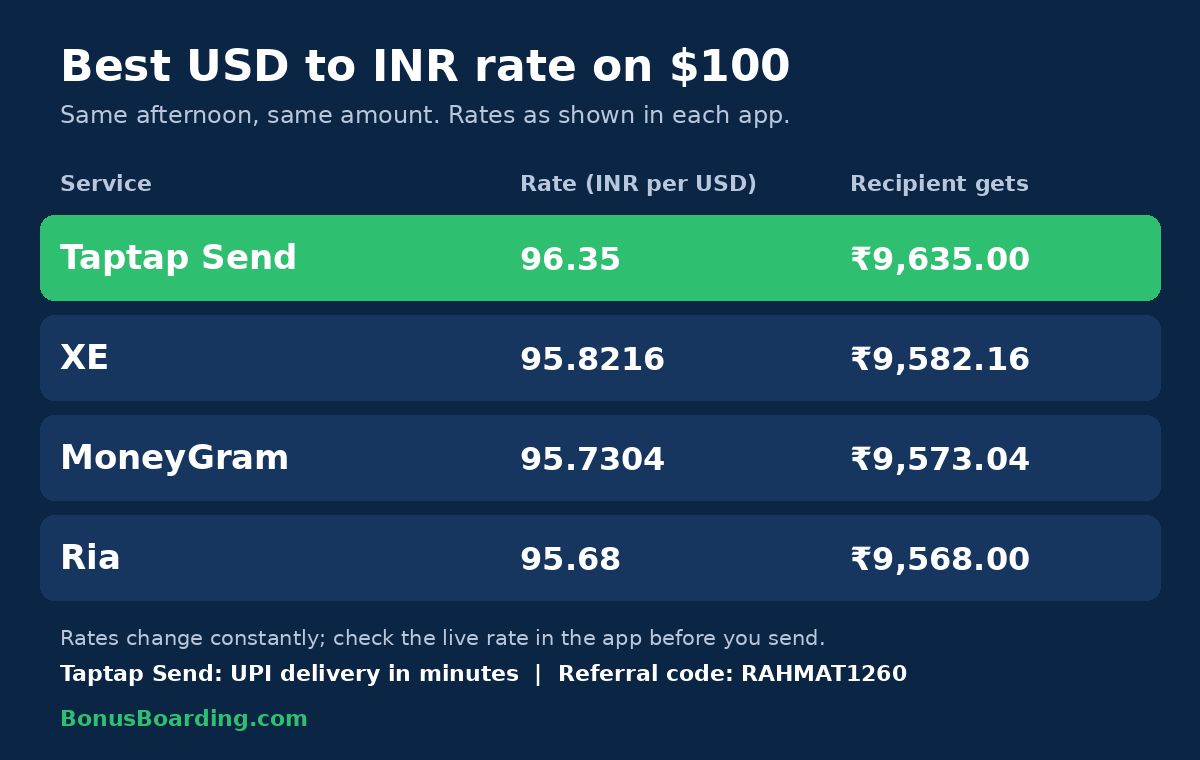
Taptap Send Review: Best USD to INR Rate Compared
What Taptap Send is, how US-to-India transfers work, and how its USD to INR rate compared with XE, MoneyGram and Ria on the same afternoon.
- Build Credit
How to Build US Credit From Zero: Secured Cards, Loans, and Quick Wins
No SSN? Thin file? Here's the honest, step-by-step roadmap to building US credit fast — with real numbers and card picks for newcomers.
Join the discussion
Share your take, ask a question, or swap tips with other readers. Be kind — we moderate.