Best Destinations to Visit on Points and Miles (and How to Get There)
Points and miles aren’t worth the same everywhere — and this is the insight that separates people who get mediocre value from those who get extraordinary value. The same 60,000 miles might get you a cramped domestic round-trip or a lie-flat business class seat halfway around the world. The art of award travel — and it’s the part I find most satisfying to optimize, honestly — is pointing your points at the destinations and routes where they deliver the most. Here’s how to think about it — and where the value tends to hide.
The principle: chase the expensive cash fares
The golden rule of destination planning is simple: your points are worth the most where the cash price is highest. A flight that costs $300 in cash and 25,000 miles gives you ~1.2 cents per mile. A flight that costs $4,000 in cash and 70,000 miles gives you nearly 6 cents per mile. Same miles, very different value.
That means the best “points destinations” are usually long-haul international trips in premium cabins, where cash prices are eye-watering but award prices stay reasonable. Don’t burn a stash of valuable transferable points on a cheap domestic hop you could have paid $89 for.
High-value destination ideas
- Europe in business class. Transferable points (Amex, Chase, Bilt apply →, Citi) feed programs like Air France-KLM Flying Blue and Avios partners that price transatlantic business class reasonably — a $4,000+ seat for a fraction in points.
- Japan and East Asia. Programs like ANA, Japan Airlines (via Alaska’s Atmos Rewards or Bilt), and Singapore KrisFlyer (via Amex/Citi) unlock some of the best premium-cabin value anywhere.
- Hawaii and beach resorts. Hotel points shine here. World of Hyatt (via Chase) and Hilton (with the fifth-night-free perk) can turn $600-a-night resorts into affordable stays.
- Domestic getaways on Southwest. With the Companion Pass, a buddy flies with you for just taxes — the best domestic value going for couples and families.
- Road trips. Wyndham’s flat-rate award tiers — starting at just 7,500 points a night — make budget and mid-range stays across the US predictable and cheap.
Match the destination to the program
The trick is reverse-engineering: decide where you want to go, then figure out which program reaches it best.
- Want European business class? Lean on Amex, Chase, or Bilt → Flying Blue and Avios partners.
- Want Asia in a premium cabin? Look at Alaska’s Atmos Rewards, Bilt, Amex, and Citi partners.
- Want luxury hotels? Chase → Hyatt is the gold standard; Hilton for volume.
- Want simple, repeatable domestic value? Southwest (Companion Pass) and Wyndham.
Plan around availability, not just price
Award seats — especially premium cabins — are limited. The travelers who get the best trips start with availability: they search for open award space first, then build the trip around it, often booking 6–11 months ahead when airlines release the most seats. Flexibility on dates and nearby airports dramatically expands your options.
Bottom Line
The best destinations on points are the ones where cash prices are highest relative to the award cost — usually long-haul international trips in business or first class, and pricey resorts booked with hotel points. Decide where you want to go, then reverse-engineer which program reaches it best (Flying Blue and Avios for Europe, Atmos/ANA/Singapore for Asia, Hyatt for luxury hotels, Southwest and Wyndham for domestic value), and start your planning with award availability rather than the calendar.
How this works in practice
Imagine a couple planning a 10th anniversary trip to Japan. They’ve been putting everyday spending on a Chase Sapphire Preferred for two years and have accumulated around 80,000 Ultimate Rewards points. Rather than booking through Chase’s travel portal (worth about $1,000 in travel credit), they do some research and discover that transferring to ANA’s loyalty program lets them book United-metal flights — or ANA flights directly — for around 60,000–70,000 miles round trip in business class, which would otherwise run $4,000–$6,000 in cash per person.
They confirm seats are available on the ANA website first. Then — and only then — they transfer their Chase points to ANA and book the award. Two economy-priced 10-year anniversary flights become a lie-flat business class experience for roughly the same points they might have used for two domestic coach seats.
The math is the whole story: they got about $4,000 in value from ~65,000 points, or roughly 6 cents per point — versus the 1.25 cents they’d have gotten booking through the portal.
Pros and cons of award travel planning
Pros:
- Dramatically higher value per point on premium-cabin awards and luxury hotels
- Lets you access flights and hotels that would otherwise be unaffordable at cash prices
- Programs like Southwest’s Companion Pass make domestic travel genuinely cheap for couples and families
- Hotel points (especially Hyatt) can unlock resort nights worth $500–$800 for a fraction of what you’d pay in cash
Cons:
- Award space is limited, especially in premium cabins — you may need to be flexible on dates or routing
- Planning takes effort: you have to search availability, understand transfer ratios, and book well in advance
- Program rules, award charts, and partners change, so a redemption that looks great today may look different in a year
- Transfers are one-way and instant — if award space disappears after you transfer, the points are stuck in the airline program
Comparing destinations: long-haul vs. domestic
For short domestic trips — say, a weekend in Nashville or a drive-distance getaway — points often add modest value over what you could book for $150–$200 on a fare sale. The math rarely pencils out as well as a transatlantic or transpacific redemption.
The general hierarchy by value:
- Transatlantic and transpacific business/first class — highest value, often 4–8 cents per point
- Luxury resorts booked with hotel points — excellent, especially with Hyatt and peak-season Hilton
- Domestic premium cabin — decent, but first class domestically is not the same value as international
- Short domestic coach — lowest value; often better to pay cash or use Southwest points where the pricing scales linearly with cash fare
If your points stash is relatively small, target one great international redemption rather than spreading points across several modest domestic trips.
Frequently asked questions
How far in advance should I search for award space?
Most airlines release their best award inventory — especially business and first class — 6 to 11 months in advance, when the initial block of seats becomes available. For popular routes (US to Europe in summer, or US to Japan around holidays), searching at the 11-month mark gives you the best odds. That said, some airlines also release space close-in (within 2–3 weeks of departure) when seats go unsold. Flexibility on both ends of the range improves your chances.
Can I mix points from different programs?
Generally, no — you cannot combine Chase Ultimate Rewards with Amex Membership Rewards points in the same transaction. However, you can transfer points from both programs into the same airline or hotel account (as long as that program is a partner of both), effectively “pooling” them into a single award booking. For example, you could transfer Chase points and Capital One miles into the same Avianca LifeMiles account and use the combined balance for one flight.
Are there destinations where hotel points beat airline miles?
Yes. For resort-heavy destinations — Hawaii, the Maldives, the Caribbean — hotel points often deliver more dollar-for-dollar value than airline miles because the cash nightly rates are so high. A Hyatt resort in Maui or a Waldorf Astoria property might cost $700–$900 per night in cash, but book for a set number of points per night. If you can book that at a points cost equivalent to 1.5–2 cents each, you’ve done very well.
What if I can’t find award space in business class?
A few strategies help: search for alternative partner airlines on the same route (many programs let you book via partners, not just their own metal), try nearby airports, look at one-way awards rather than round-trip (gives more flexibility), and set alerts with tools that notify you when award space opens. Positioning flights (a cheap domestic leg to a gateway city) can also unlock better international award options.
Do I need multiple credit cards to do this effectively?
Not necessarily. Starting with a single good transferable-points card — like the Chase Sapphire Preferred — is enough to begin. Over time, adding a second card from a different bank (for example, an Amex card to access Membership Rewards partners) expands your options. But one well-chosen card with a strong welcome bonus can fund a meaningful trip by itself.
Keep reading
- Credit for Immigrants
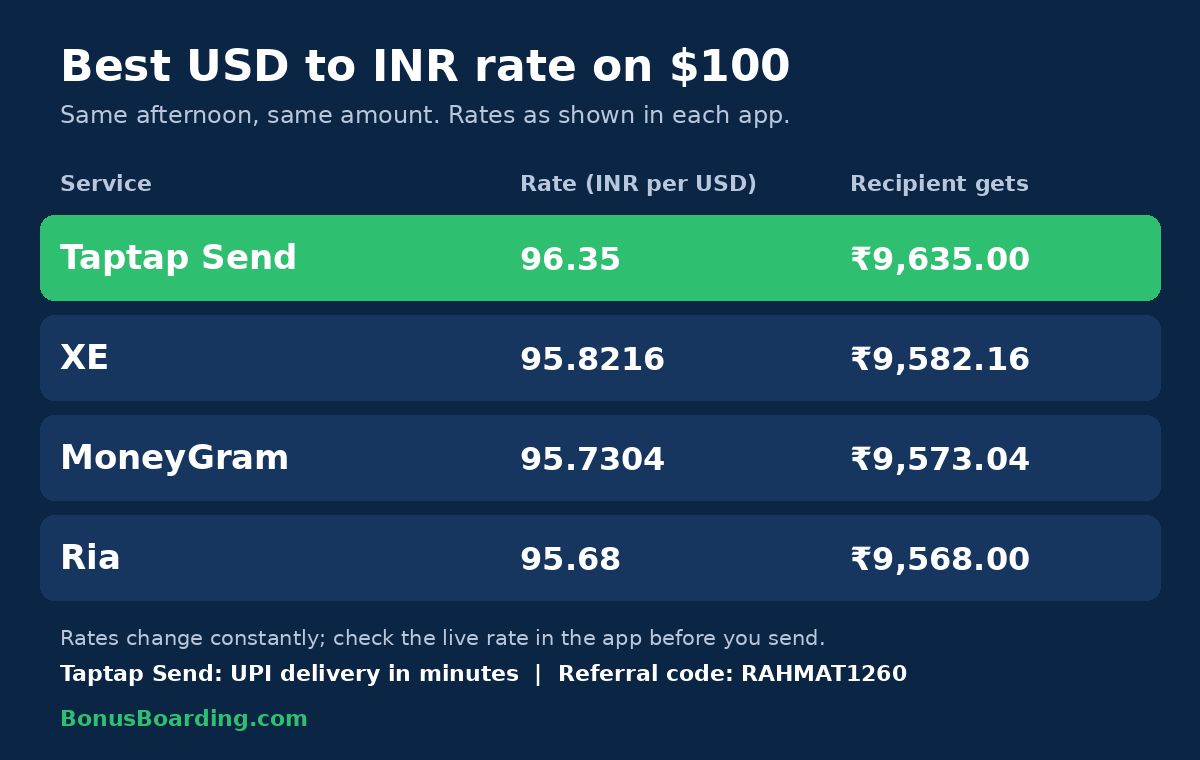
Taptap Send Review: Best USD to INR Rate Compared
What Taptap Send is, how US-to-India transfers work, and how its USD to INR rate compared with XE, MoneyGram and Ria on the same afternoon.
- Build Credit
How to Build US Credit From Zero: Secured Cards, Loans, and Quick Wins
No SSN? Thin file? Here's the honest, step-by-step roadmap to building US credit fast — with real numbers and card picks for newcomers.
- Business Cards
How to Build US Business Credit as a Newcomer: First Steps
No SSN? No credit history? Here's exactly how H-1B workers, F-1 students, and new immigrants start building US business credit from zero.


Join the discussion
Share your take, ask a question, or swap tips with other readers. Be kind — we moderate.