TSA PreCheck vs. Global Entry vs. CLEAR: Which to Get (and Get Free)
Three programs promise to get you through the airport faster — TSA PreCheck, Global Entry, and CLEAR — and they’re easy to confuse. They do different things, cost different amounts, and in many cases I’d recommend getting more than one. your credit card will pay the fee for you. Here’s how to choose.
TSA PreCheck — the security line speed-up
TSA PreCheck gets you a dedicated, faster security lane at US airports where you keep your shoes, belt, and light jacket on and leave laptops and liquids in your bag. It costs about $78 for five years. For domestic travelers, this is the single highest-impact program — it’s the one that turns a 25-minute security slog into a few minutes.
Global Entry — PreCheck plus customs
Global Entry does everything PreCheck does and speeds you through US customs and immigration when returning from abroad, using kiosks instead of the long arrivals line. It costs $120 for five years and includes TSA PreCheck. The math is simple: for $42 more than PreCheck alone, you also get expedited customs. If you travel internationally even occasionally, get Global Entry instead of PreCheck — it’s the better value.
CLEAR Plus — skip to the front of the line
CLEAR is different: it uses your eyes or fingerprints to verify your identity and walks you to the front of the security line (where you then go through PreCheck screening if you have it). It’s a private service, not a government program, and it’s pricier at about $209 per year. CLEAR is most worth it at busy home airports where the lines are long — and it pairs best with PreCheck, not instead of it.
How to get the fee for free
Here’s the part most people miss: many travel credit cards reimburse these fees automatically. A card with this benefit pays for itself on this perk alone.
- TSA PreCheck / Global Entry: Premium cards like the Amex Platinum apply → and Capital One Venture/Venture X reimburse the application fee (up to $120) every four years. More affordable options like the Bank of America Premium Rewards and U.S. Bank Altitude Connect offer up to $100 every four years.
- CLEAR Plus: The Amex Platinum, Business Platinum, Green, and Hilton Aspire cards reimburse CLEAR Plus (around $209) per calendar year — enrollment required.
If you already carry one of these cards, simply pay the application fee with it and the statement credit posts automatically.
Which should you get?
- Fly mostly domestic? Get TSA PreCheck (or Global Entry, since it includes PreCheck for just a bit more).
- Travel internationally at all? Get Global Entry — it’s the best overall value.
- Home airport with brutal lines and you already have PreCheck? Add CLEAR on top.
- Either way: put the fee on a card that reimburses it so you pay nothing.
Bottom Line
For most travelers, Global Entry is the smart pick — it includes TSA PreCheck and adds expedited customs for just $42 more, all for five years. CLEAR is a worthwhile add-on at busy airports but it’s a yearly cost. Best of all, premium cards like the Amex Platinum and Capital One Venture apply → reimburse these fees, so the right card makes airport speed essentially free. Just remember to pay the application fee with that card.
How this works in practice
Take a traveler who flies domestically four or five times a year and takes one international trip. She currently waits through the standard TSA line — sometimes 20 minutes, sometimes 40 minutes depending on the airport and day. She holds an Amex Platinum card that reimburses Global Entry (up to $120) automatically when she pays the application fee with the card.
She applies for Global Entry, schedules the interview (available at most major international airports during arrivals, or at enrollment centers), gets approved, and from that point forward: she uses the PreCheck lane on every domestic flight (shoes on, laptop in bag, through in under five minutes), and when she lands back from an international trip she walks to a kiosk, scans her passport, answers a few questions, and is done — no waiting in the customs line that used to take 30–45 minutes.
Her cost: $0 — the Amex Platinum reimbursed the $120 application fee. Her time savings: easily 10–15 hours per year. For a business traveler that math is even more compelling.
If she were based at a busy hub like LAX or JFK and her home airport security line regularly stretches 30+ minutes, adding CLEAR Plus (also covered by the Amex Platinum) would let her skip even the PreCheck line entirely — walking past it to the front. That’s useful at certain airports and at certain times of day, though overkill for smaller or less congested airports.
Pros and cons
TSA PreCheck — pros:
- Dramatically faster security experience at participating airports
- Keeps shoes, belt, and light jacket on; no unpacking electronics or liquids
- Valid for five years; covers you on any airline at any participating airport
- Cheapest of the three programs at around $78
TSA PreCheck — cons:
- Domestic security only; no help at customs when returning from abroad
- Not available at every airport (though most major US airports participate)
- PreCheck lanes can get crowded at peak times if many travelers have it
Global Entry — pros:
- Includes everything PreCheck gives you, plus expedited US customs
- Best overall value: only ~$42 more than PreCheck alone for five years
- Works at all major US airports with customs facilities
- Includes NEXUS benefits for travel to Canada
Global Entry — cons:
- Requires an in-person interview (scheduling can take weeks or months at busy offices)
- $120 upfront, though many credit cards reimburse it
- Does not help with customs in other countries (only US re-entry)
CLEAR Plus — pros:
- Biometric identity verification lets you skip to the front of the security line
- Pairs well with PreCheck for the fastest possible airport experience
- No government interview required
CLEAR Plus — cons:
- Expensive at around $209 per year (versus $78 or $120 one-time every five years)
- Not available at every airport; most useful at major hubs
- Does not replace PreCheck — you still go through the same screening, just at the front of the line
- Not government-backed; CLEAR is a private company
Comparing Global Entry and NEXUS
If you frequently cross the US-Canada border, NEXUS ($50 for five years) is worth knowing about. It provides the same expedited US customs as Global Entry, works at the Canadian border, and — for US citizens — also grants TSA PreCheck. If Canada travel is part of your routine, NEXUS is the best deal of all. For most travelers who fly internationally but not frequently to Canada, Global Entry is the right call.
Frequently asked questions
How long does Global Entry approval take?
The application process has two parts: an online application (CBP approval can take weeks to months, depending on volume) and then an in-person interview. Many people schedule the interview for a trip where they’re re-entering the US internationally — the interview takes 10–15 minutes at the airport and is one of the fastest ways to complete it without a separate trip to an enrollment center. Once approved, you’re enrolled immediately.
Can my family member use my card’s Global Entry credit?
Most cards only cover one reimbursement per account per cycle — so the credit covers the primary cardholder or one person. Some premium cards (like the Amex Business Platinum) allow authorized users to also receive a reimbursement, but the rules vary by card. Check your specific card’s terms.
Does PreCheck work on international flights departing the US?
Yes — TSA PreCheck applies to the US security screening for international departures (the checkpoint before your gate), so you get the faster lane when flying out of a US airport. It does not apply to security in foreign countries.
What if my PreCheck isn’t showing on my boarding pass?
Make sure your Known Traveler Number (KTN) is entered in your airline profile and in each booking. It’s easy to overlook when booking through a third-party site or points redemption. You can add it after booking through your airline’s “Manage My Booking” or loyalty account settings.
Is CLEAR worth it if I already have PreCheck?
At busy airports with long PreCheck lines — think LAX, JFK, ORD, or ATL during peak hours — CLEAR can save meaningful time by letting you skip the PreCheck queue itself. At smaller or less congested airports, the benefit is minimal. It’s most worth it if your home airport is a major hub and you fly frequently enough to experience the PreCheck lane getting backed up.
Keep reading
- Credit for Immigrants
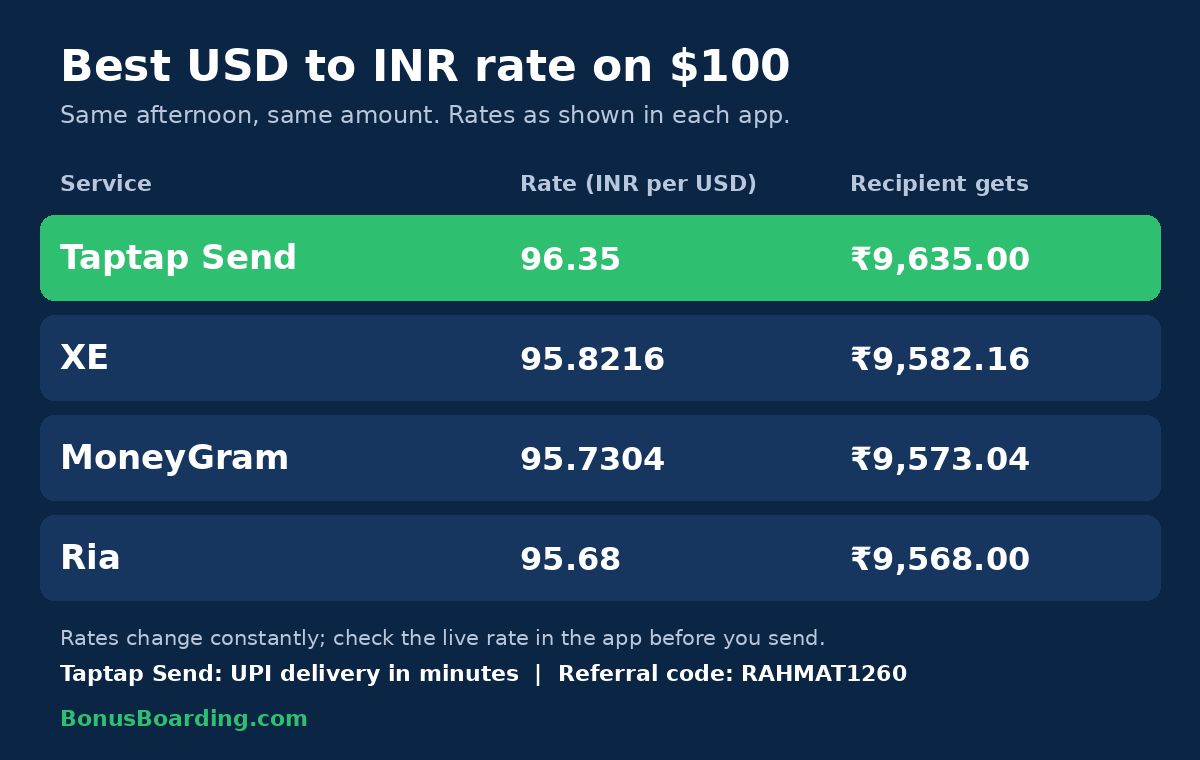
Taptap Send Review: Best USD to INR Rate Compared
What Taptap Send is, how US-to-India transfers work, and how its USD to INR rate compared with XE, MoneyGram and Ria on the same afternoon.
- Build Credit
How to Build US Credit From Zero: Secured Cards, Loans, and Quick Wins
No SSN? Thin file? Here's the honest, step-by-step roadmap to building US credit fast — with real numbers and card picks for newcomers.
- Business Cards
How to Build US Business Credit as a Newcomer: First Steps
No SSN? No credit history? Here's exactly how H-1B workers, F-1 students, and new immigrants start building US business credit from zero.

Join the discussion
Share your take, ask a question, or swap tips with other readers. Be kind — we moderate.