How to Find Cheap Flights and Flight Deals (Cash and Award)

Flight deals come in two flavors: cheap cash fares and well-priced award seats you book with points. The travelers who consistently fly for less aren’t lucky — they have a system, and honestly, the system isn’t complicated once you know what to look for. Here’s how to do both.
Finding cheap cash fares
- Be flexible on dates and airports. The single biggest lever on price is flexibility. Use the “flexible dates” and “nearby airports” tools on flight search engines to see where the cheap days hide.
- Use a fare search engine with a calendar view (Google Flights and similar) to spot the cheapest dates at a glance, and set price alerts for routes you care about.
- Watch for fare drops and sales. Airlines run periodic sales; deal-alert services flag unusually low fares, including rare mistake fares (pricing errors) that can be a fraction of normal cost — book fast, as they don’t last.
- Consider one-way combinations and positioning flights, which can sometimes beat a single round-trip fare.
Finding award-seat deals
Booking with points is its own kind of deal-hunting, and the value is highest where cash fares are most expensive:
- Target premium cabins on long-haul routes, where a $4,000 seat might cost 60,000 miles — far better value than a cheap economy hop.
- Use the right program for the route. Different airlines price the same flight very differently in miles; transferable points (Amex, Chase, Capital One, Citi, Bilt apply →) let you pick the cheapest program.
- Search award availability early. Airlines release the most award seats roughly 6–11 months out and again close to departure. Flexibility dramatically expands what’s bookable.
- Stack transfer bonuses. If a transfer bonus is running to the program you need, your award gets even cheaper.
Tools and habits that pay off
- Set price alerts on your target routes so deals come to you.
- Follow a deal-alert service for cash fares and mistake fares.
- Keep a flexible points balance (transferable currencies) so you can jump on award deals across many airlines.
- Move quickly — the best fares and award seats disappear fast.
Bottom Line
Cheap flights come from flexibility and a system: use calendar-view search and price alerts for cash fares, watch deal services for sales and mistake fares, and for awards, aim points at expensive long-haul premium cabins using whichever program prices the route cheapest. Keep a flexible points balance, search award space early, and be ready to book fast — the best deals never last long.
How this works in practice
Here is a realistic scenario showing both cash and award deal-finding in action:
A traveler based in Chicago wants to visit Lisbon, Portugal. Cash round-trip fares typically run $700–$1,200 from O’Hare. She sets up a Google Flights price alert and also subscribes to a deal-alert newsletter. Three weeks later, she gets a notification: a sale has dropped the fare to $420 round-trip on a non-stop with a major carrier. She books immediately — that deal is gone within 48 hours.
Separately, she has been building up Chase Ultimate Rewards points. For a future trip to Tokyo, she searches award availability 10 months out. She finds business-class seats on a Star Alliance partner through Air Canada Aeroplan for a point cost well below what she would expect to pay at the portal rate. She transfers exactly the points she needs from Chase to Aeroplan — confirming the seat was bookable before transferring — and books. Her out-of-pocket is just taxes.
Two different methods, two very different trips, both cheaper than the default path. The system is: have alerts set up for cash routes you care about, hold a flexible points balance for award opportunities, and be ready to move fast on either.
Building a deal-finding system
The travelers who consistently fly for less are not simply lucky. They have built habits that make deals come to them rather than hunting manually:
For cash fares:
- Set Google Flights price alerts on every route you fly more than once a year
- Follow at least one deal-alert service by email so unusual fares land in your inbox
- Check the “Explore” view on Google Flights occasionally — it shows cheap fares across all destinations from your home airport, which can spark trip ideas you had not considered
For award seats:
- Keep transferable points (Chase, Amex, Capital One, Citi) rather than siloing everything in a single airline program — this lets you reach whichever partner has availability
- Learn which programs cover your most frequent routes (Aeroplan for transatlantic and transpacific Star Alliance, AAdvantage for oneworld, MileagePlus for United nonstops)
- Search award calendars 6–11 months out for popular routes and again within 2–3 weeks of departure
- Monitor transfer bonus announcements — a 25–40% bonus on a transfer to a program you need cuts the effective point cost substantially
Mistake fares: what they are and how to catch them
A mistake fare is a pricing error — an airline or booking system accidentally prices a ticket at a fraction of the normal cost, sometimes by an order of magnitude. A business-class fare to Europe at economy prices, or a $200 transatlantic round-trip, are classic examples.
To catch mistake fares you need:
- A deal-alert service that specifically watches for them (not all do)
- The habit of checking your email quickly — most mistake fares are corrected within hours
- A flexible approach to travel dates, since mistake fares are rarely on your ideal days
- The willingness to book before being certain the deal survives (some do, some are canceled by the airline)
Airlines are not legally required to honor mistake fares in the US, though many do honor them for goodwill reasons. Book refundable travel like hotels and backup plans only after the ticket has been ticketed and confirmed.
Pros and cons of a deal-focused approach
Pros
- Significant savings on flights you would take anyway
- Award deals at their best deliver business-class travel at economy-ish point costs
- Alerts make deal-finding largely passive once the system is set up
- Flexibility compounds the savings — even one open day in your travel window often drops the price noticeably
Cons
- Requires genuine flexibility; the best deals rarely land on your ideal exact dates
- Mistake fares can be canceled, leaving you scrambling
- Award availability on desirable routes is competitive and requires advance planning
- Point-balance management adds complexity — idle miles can devalue without notice
Frequently asked questions
Which flight search engine is best for finding cheap cash fares?
Google Flights is the most widely used for its calendar view and price alert functionality. It covers most major airlines and many budget carriers. For international routes, also check the airline’s direct site — sometimes direct booking is slightly cheaper, and corporate or loyalty perks apply only on direct bookings. Budget airlines in Europe (Ryanair, easyJet) and Asia may not appear on aggregators at all.
How far in advance should I buy a domestic flight?
Research suggests domestic US fares are often cheapest 1–3 months before departure for leisure routes. Buying too far in advance or too close to departure tends to cost more. That said, sales and mistake fares blow up this rule regularly — if a fare alert fires at six months out and the price is exceptional, book it.
Is it worth booking one-way flights separately?
Yes, frequently. Two one-way tickets on different airlines can be cheaper than a round-trip, especially on transatlantic routes. The downside is if one leg is delayed or canceled, the other airline owes you nothing — you are holding separate tickets. For budget-conscious travelers with flexible plans, the savings often outweigh this risk.
How do I know if an award redemption is good value?
A commonly used benchmark is whether you are getting at least 1.5 cents per point in value. Business-class international awards often deliver 2–4 cents per point when the cash price of the same seat is high. Economy award redemptions on cheap cash routes deliver much less — sometimes barely better than the portal rate. The rule of thumb: use points where cash prices are highest, not where award prices seem lowest.
Can I combine award and cash travel on the same itinerary?
Sometimes. Booking separate one-way award tickets for different legs of a journey is a legitimate strategy. You might book a business-class award on the long transoceanic segment and pay cash for a short connecting flight — especially if the connecting leg is cheap and not available on points. Just make sure each leg is ticketed independently and you have buffer time between connections.
Comparing cash deals vs. award travel: when each wins
| Scenario | Cash deal often wins | Award travel often wins |
|---|---|---|
| Short domestic hops | Yes — award overhead not worth it | Rarely |
| Cheap transatlantic economy | Sometimes — especially if a mistake fare | Decent |
| Business class international | Rarely — cash prices are very high | Yes — highest value advantage |
| Last-minute travel | Cash sales can appear | Award space is thin |
| Fixed dates, specific flights | Cash (more flexibility of supply) | Award (if space opened early) |
The smart move is using both: cash for short flexible trips, awards for the premium long-haul seats where your points really stretch.
Related reading
Keep reading
- Credit for Immigrants
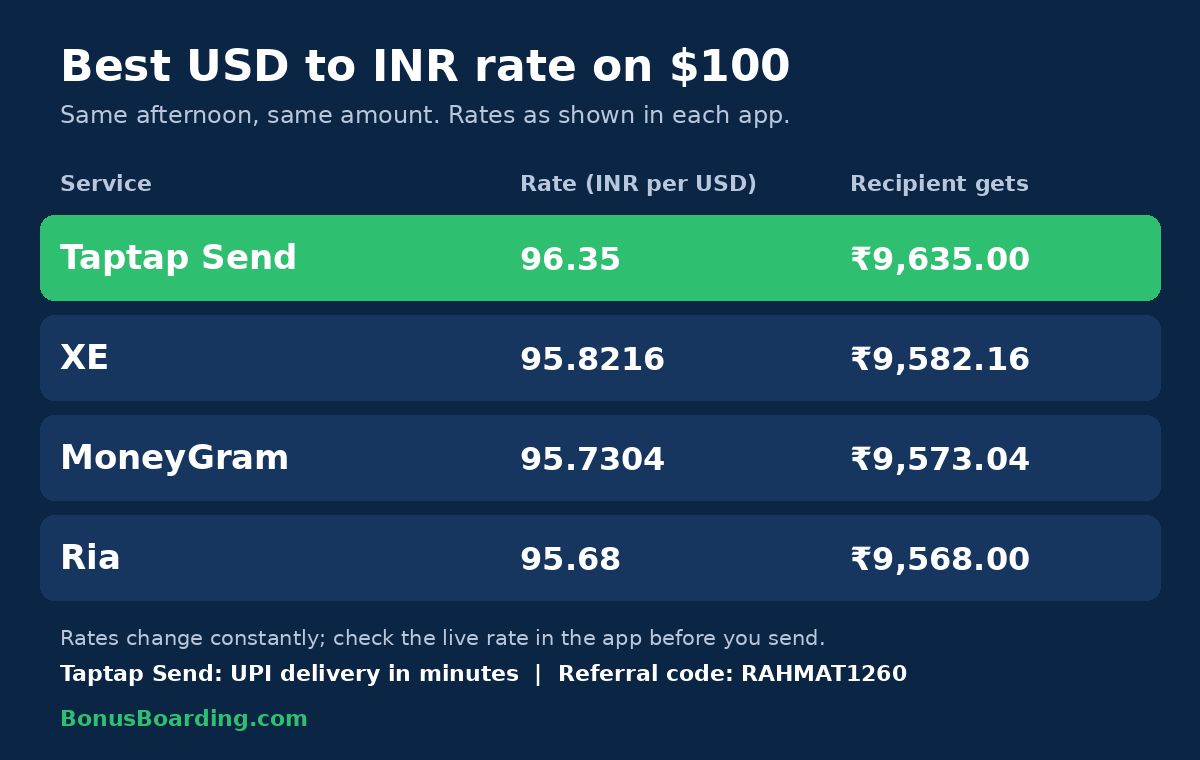
Taptap Send Review: Best USD to INR Rate Compared
What Taptap Send is, how US-to-India transfers work, and how its USD to INR rate compared with XE, MoneyGram and Ria on the same afternoon.
- Build Credit
How to Build US Credit From Zero: Secured Cards, Loans, and Quick Wins
No SSN? Thin file? Here's the honest, step-by-step roadmap to building US credit fast — with real numbers and card picks for newcomers.
- Business Cards
How to Build US Business Credit as a Newcomer: First Steps
No SSN? No credit history? Here's exactly how H-1B workers, F-1 students, and new immigrants start building US business credit from zero.


Join the discussion
Share your take, ask a question, or swap tips with other readers. Be kind — we moderate.