Chase Just Killed 1:1 Hyatt Transfers on the Sapphire Preferred and Ink Business Preferred
If World of Hyatt is the reason you’ve been hoarding Chase points, read this before tomorrow. Here’s my honest take on what this actually means for your strategy. Chase is dropping the Ultimate Rewards-to-Hyatt transfer ratio from 1:1 to 4:3 on the Sapphire Preferred and the Ink Business Preferred. That means 4 Chase points will get you just 3 Hyatt points instead of 4. It’s a 25% haircut on the single best use most people had for Ultimate Rewards, and it lands on a chunk of cardholders in a matter of hours.
The one thing you can still control is timing. So let’s get the dates and the math straight, then talk about what’s actually worth doing.
The two dates that matter
There are two deadlines, and which one applies depends entirely on your card.
If you apply for a Sapphire Preferred or Ink Business Preferred on or after June 15, 2026, you get the 4:3 ratio immediately. No grandfathering, no grace period. The old 1:1 rate is simply gone for you.
If you already hold one of those cards (or apply before June 15), you keep 1:1 transfers to Hyatt until October 1, 2026. On that date, you flip to 4:3 like everyone else. The same downgrade hits the legacy Ink Plus and Ink Business Corporate Flex cards.
There’s one important exception. The Chase Sapphire Reserve and the Sapphire Reserve for Business keep the 1:1 ratio to Hyatt. After October 1, those two cards are the only way to move Chase points to Hyatt at full value.
So if you’re a current Sapphire Preferred or Ink Preferred holder, you have a real, if shrinking, window: until October 1 to either transfer points you’ll actually use, or rethink where your points live.
What 4:3 actually does to your points
Here’s the part that stings. Hyatt already gutted its own award chart on May 20, 2026, splitting every category into five price tiers and creating well over a hundred different standard-room rates. Layer the 4:3 transfer ratio on top of that and you get a double devaluation.
Take a property that prices at 20,000 Hyatt points a night. Under the old setup, you transferred 20,000 Chase points and you were done. Now you’ll need to send 27,000 Chase points to end up with 20,250 Hyatt points — and you’re forced to transfer in 1,000-point increments, so you can’t even hit the number cleanly. You overshoot, and the leftover Hyatt points just sit there orphaned.
Run it across the chart and the increases are brutal. Comparing the old “standard” rates to the new “moderate” rates, the number of Chase points you need climbs roughly 60% to 80% depending on category. A Category 4 hotel at its top price now wants 34,000 Chase points a night (you have to round up to the next 1,000), versus 18,000 at the old peak rate. That’s an 85% jump in points for the same room.
Run the cents-per-point math
The cleanest way to judge any transfer is what each point is actually worth when it lands.
TPG’s June 2026 valuation pegs World of Hyatt points at about 1.55 cents each, and they expect that to keep sliding toward 1.5 cents as the new award chart’s data settles in. At 1:1, transferring a Chase point to Hyatt and redeeming at 1.5 cents got you 1.5 cents of value per Chase point. Not bad at all.
At 4:3, you’re handing over 4 Chase points to get 3 Hyatt points worth roughly 1.5 cents apiece. That’s 4.5 cents of value for 4 points, or about 1.1 cents per Chase point. And that’s only if you’re redeeming Hyatt points at a solid rate. Redeem at the low end and you’re underwater.
Here’s a concrete example. Say you want a Category 2 hotel at its “moderate” tier: 10,000 Hyatt points a night, against a $125 cash rate. To get those 10,000 Hyatt points at 4:3, you transfer 14,000 Chase points. That works out to about 0.9 cents per Chase point. Compare that to just redeeming Chase points for cash — many Chase cards let you cash out at 1 cent per point flat. You’d come out ahead pocketing 12,500 points for $125 and paying cash for the room. When transferring to a marquee hotel partner is worse than cashing out, the partner has basically stopped being useful.
The upshot: after this change, transferring Sapphire Preferred or Ink Preferred points to Hyatt only makes sense at the very top end — think outsized redemptions where you’re squeezing 2.5+ cents of value out of each Hyatt point. For everyday stays, Hyatt is effectively off the table as a Chase partner.
What to actually do
Don’t panic-transfer. The worst move here is dumping a big Chase balance into Hyatt “to lock in 1:1” with no specific stay in mind. Hyatt points can devalue too — they just did — and once they’re in Hyatt, they can’t come back out. Speculative transfers are how people end up sitting on a pile of points for a program that keeps getting worse.
Instead, work through this in order.
If you have a stay you’ll actually book in the next several months, and you hold a Sapphire Preferred or Ink Preferred, transfer for that specific booking before October 1 while you still get 1:1. A confirmed Hyatt reservation you’ll genuinely use is the one clear win here. Transfer only what that stay needs, rounded to the nearest 1,000.
If you have a Sapphire Reserve or Reserve for Business, do nothing. You keep 1:1. This change quietly makes the Reserve’s transfer access more valuable, even if the $795 annual fee and its coupon-book benefits are a tougher sell. If you were planning to downgrade a Reserve to a Preferred to dodge the fee, this is a reason to at least pause and rerun the numbers — downgrading now means giving up your only 1:1 line to Hyatt.
If Hyatt was your whole Chase strategy and you don’t want to pay for a Reserve, it’s worth knowing that Bilt Rewards still transfers to Hyatt at 1:1, and Bilt shares Chase’s hard-to-find partners like United and Southwest. It’s not a one-for-one replacement, and Bilt has its own quirks, but it’s the obvious hedge if Hyatt redemptions are your bread and butter.
For everyone else, the calm move is to stop treating Chase points as a Hyatt piggy bank and lean into the partners that still deliver. United MileagePlus, Southwest Rapid Rewards, and JetBlue TrueBlue are still solid 1:1 Chase transfers, and Chase runs the occasional airline transfer bonus worth catching. Your points aren’t worthless — they’re just no longer a shortcut to cheap Hyatt nights.
Bottom line
If you’re a current Sapphire Preferred or Ink Business Preferred cardholder, you have until October 1, 2026 at the 1:1 Hyatt rate — use it only for stays you’ll really book, and don’t speculatively transfer. If you’re applying for either card, know that signing up on or after June 15 means you’re at 4:3 from day one, so there’s no rush to apply just for Hyatt access. And if Hyatt is central to how you travel, the two clean answers are keeping a Sapphire Reserve or building up Bilt instead. Check whether you’ve got a Hyatt stay worth locking in before fall — that’s the one move with a real deadline.
Keep reading
- Chase Ultimate Rewards
Chase Improved Sapphire Preferred, But UR Feels Less Safe
The Sapphire Preferred refresh helps everyday cardholders, but a Hyatt transfer cut changes how I’d value and store Chase Ultimate Rewards.
- Chase Ultimate Rewards
Chase Ultimate Rewards: A Beginner's Guide to the Best All-Around Points
Chase Ultimate Rewards points transfer 1:1 to Hyatt, United, and more — with no penalty ratios. Here's how to earn and maximize them in 2026.
- Credit for Immigrants
Taptap Send Review: Best USD to INR Rate Compared
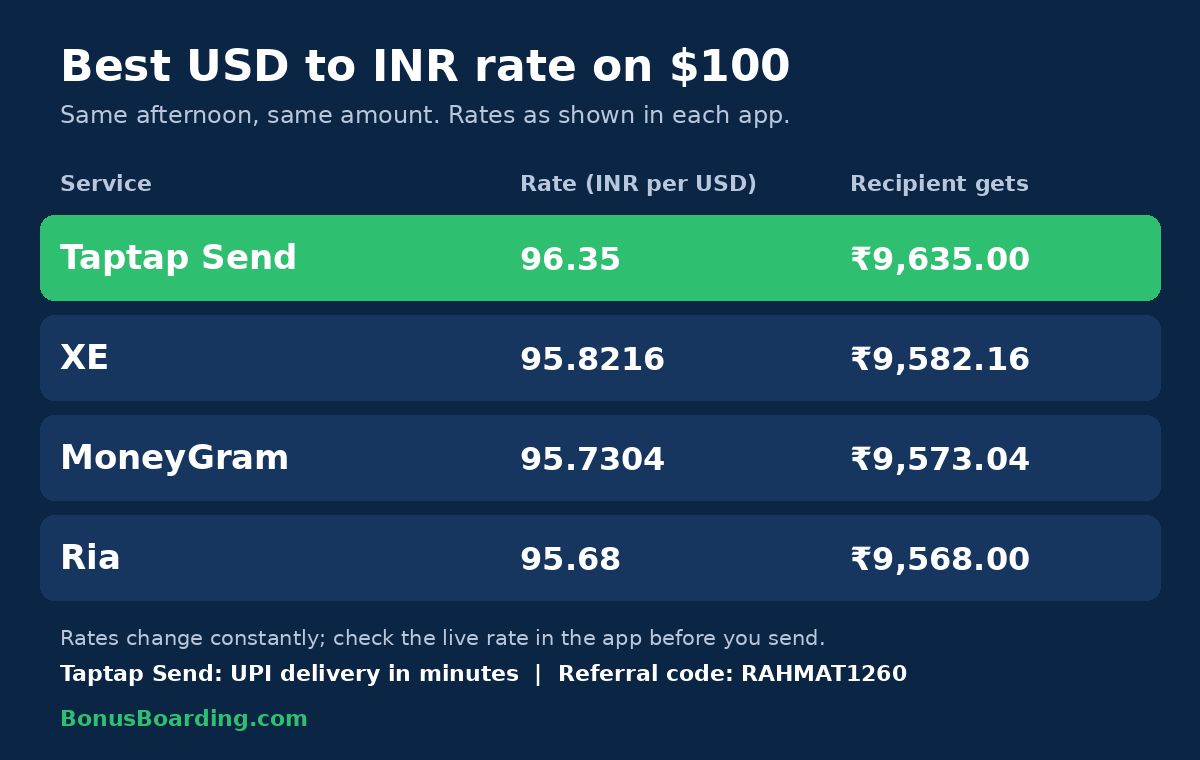
What Taptap Send is, how US-to-India transfers work, and how its USD to INR rate compared with XE, MoneyGram and Ria on the same afternoon.

Join the discussion
Share your take, ask a question, or swap tips with other readers. Be kind — we moderate.