Chase Ultimate Rewards: A Beginner's Guide to the Best All-Around Points

If you’re going to commit to one points currency as a beginner, Chase Ultimate Rewards is the easiest to recommend — and honestly, it’s the one I’d tell almost anyone to start with. It combines simple earning, a beginner-friendly set of transfer partners, and one genuinely elite redemption (World of Hyatt) that no competitor can match on the same terms. Here’s how it works in 2026.
How you earn Ultimate Rewards
You earn Chase points through the Sapphire, Freedom, and Ink families of cards. The Freedom cards earn strong bonus points in rotating and fixed everyday categories; the Sapphire and Ink cards earn well on travel and dining and — most importantly — unlock the ability to transfer points to partners. A common beginner setup is a Freedom card (for category earning) paired with a Sapphire Preferred (to enable transfers) — points pool together across your Chase cards.
Why Chase points are so valuable
Two reasons stand out, and in my view they’re hard to beat:
Every airline partner transfers at a clean 1:1 with no penalty ratios. That’s not true of Amex, which has a few 5:4 partners. With Chase, what you see is what you get — 1,000 points become 1,000 miles, every time. Chase’s lineup includes United, Air Canada Aeroplan, British Airways/Iberia Avios, Virgin Atlantic, Air France-KLM Flying Blue, Southwest, and JetBlue, among others.
The Hyatt transfer is the crown jewel. Chase transfers 1:1 to World of Hyatt, widely considered the most valuable hotel program because its award chart still delivers luxury hotels for reasonable point totals. A night that costs $700+ in cash can often be booked for points worth a fraction of that. No other transferable program offers Hyatt.
Chase also added Wyndham, Marriott, and IHG as hotel partners (Wyndham joined in early 2026), giving four hotel options in total.
What the points are worth
Redeemed for cash back, Chase points are worth 1 cent each. Through the travel portal they’re worth a bit more on premium cards. But the real value — often 2 cents per point or more — comes from transferring to partners, especially Hyatt and premium-cabin airline awards.
The smartest ways to use Chase points
- Transfer to Hyatt for hotel stays — this is the single best use and the program’s signature move.
- Transfer to airline partners 1:1 for flights, confirming award availability first.
- Pair a Freedom card with a Sapphire to combine strong category earning with transfer access.
- Skip gift cards and merchandise — value drops below 1 cent, and I’ve never seen a case where that made sense.
Bottom Line
Chase Ultimate Rewards is, in my opinion, the best all-around starting point in points: simple to earn across the Sapphire, Freedom, and Ink cards, with airline partners that all transfer at a clean 1:1 and the unbeatable 1:1 Hyatt transfer for hotels. Redeem for cash in a pinch, but the magic is transferring to partners — especially Hyatt — where your points are routinely worth 2 cents or more.
Part of our complete Points & Miles guide. Not sure what your points are worth? See the latest points valuations or run the numbers with our free calculators.
How this works in practice
Picture Jordan, a frequent road traveler who stays at hotels several times a year. He carries the Chase Freedom Unlimited for everyday spending (1.5x on everything) and the Chase Sapphire Preferred for dining and travel purchases (3x dining, 2x travel). Points from both cards pool into his Sapphire account, enabling transfers.
After 8 months, Jordan has accumulated 45,000 Ultimate Rewards points. He wants a two-night weekend stay at a Hyatt Andaz property where rooms run $350/night — $700 total.
He searches the World of Hyatt award chart, finds the property is a Category 4, and sees it prices at 15,000 points per night (standard award). He transfers 30,000 Chase points to his Hyatt account — the transfer completes in minutes — and books two free nights.
He paid $700 worth of hotels for 30,000 points. That is 2.33 cents per point — more than double the 1-cent-per-point cash-back value and well above the travel portal rate. His remaining 15,000 points are sitting for the next redemption.
This is the Chase playbook: earn on everyday spending with Freedom cards, transfer through Sapphire to Hyatt, and repeat.
Pros and cons of Chase Ultimate Rewards
Pros
- Every transfer partner is 1:1, no exceptions — what you see is what you get, no 5:4 penalty ratios to track.
- The Hyatt transfer is the single best hotel redemption available in any transferable program, delivering consistent high-cents-per-point value.
- The Freedom card family earns strong category bonuses (5x rotating categories, 3x dining on Freedom Unlimited with Sapphire pairing) at no annual fee — a true workhorse setup.
- Chase’s approval requirements are predictable: the 5/24 rule is strict but clear, so you can plan your application sequence.
- The Sapphire Preferred has a modest annual fee relative to the benefits it unlocks, including trip delay reimbursement and primary rental car coverage.
Cons
- The 5/24 rule means you can only have opened five new accounts (any bank) in the past 24 months to be approved for most Chase cards. Applying for other cards first can shut you out of Chase.
- Chase has no Delta transfer partner. If you fly Delta primarily, Amex is the only transferable route.
- The partner list is smaller than Amex’s (about 11 airline partners vs. roughly 17 for Amex).
- Chase does not run transfer bonuses as frequently as Capital One or Amex, so you transfer at standard 1:1 ratios most of the time.
Chase Ultimate Rewards vs. Amex Membership Rewards
These are the two most popular transferable programs, and both are worth knowing.
Chase advantages: Clean 1:1 ratios across all partners. The Hyatt transfer — unmatched for hotel value. A strong no-annual-fee earning card (Freedom Unlimited) that pairs seamlessly with the Sapphire.
Amex advantages: Far more airline partners — especially the exclusive 1:1 Delta path, multiple European carriers, and more Asian airline options. Frequent transfer bonuses. Strong earning on the Gold card at US supermarkets.
Bottom line on the comparison: If you primarily want hotel value and simplicity, Chase wins. If you fly internationally to diverse destinations and want maximum partner flexibility, Amex’s roster is harder to beat. Many experienced points collectors hold both.
Frequently asked questions
What is the Chase 5/24 rule and how does it affect me?
Chase’s informal 5/24 rule means you will generally be denied for most Chase cards if you have opened five or more new credit card accounts across all banks in the past 24 months. It counts all personal card openings — not just Chase cards. If you are building a points strategy, prioritize Chase cards first, before opening cards from other banks.
Can I transfer Chase points to someone else’s airline account?
Chase allows transfers to your own loyalty accounts, plus household members’ accounts for some partners. The rules vary by partner — Hyatt, for example, allows transfers to any Hyatt account. Airline programs are generally more restrictive. Check each partner’s rules before assuming a third-party transfer is possible.
Do Chase Ultimate Rewards points expire?
Points do not expire as long as your account is open. If you close your Sapphire or Ink card (the ones that enable transfers), your points will revert to cash-back-only status — you lose transfer access but keep the points. To preserve transfer ability, keep at least one premium Chase card open.
Is the Sapphire Preferred or Sapphire Reserve better for beginners?
The Sapphire Preferred is almost always the better starting card. Its annual fee is significantly lower than the Reserve’s, and it still unlocks all the same transfer partners plus solid travel protections. The Reserve makes sense once you travel enough to extract value from its higher-tier perks and credits. Most points guides recommend starting with the Preferred.
How long do Chase point transfers take?
Transfers to most Chase airline partners (United, British Airways, Air France-KLM, and others) complete within minutes to a few hours. Hotel transfers (Hyatt, IHG, Marriott) also tend to be fast. Confirm award availability in the partner program first, then transfer — there is no reason to move points before you have a booking to make.
Keep reading
- Chase Ultimate Rewards
Chase Improved Sapphire Preferred, But UR Feels Less Safe
The Sapphire Preferred refresh helps everyday cardholders, but a Hyatt transfer cut changes how I’d value and store Chase Ultimate Rewards.
- Chase Ultimate Rewards
Chase Just Killed 1:1 Hyatt Transfers on the Sapphire Preferred and Ink Business Preferred
Chase is cutting Ultimate Rewards-to-Hyatt transfers to 4:3 on the Sapphire Preferred and Ink Business Preferred. Here's the deadline and what to do.
- Credit for Immigrants
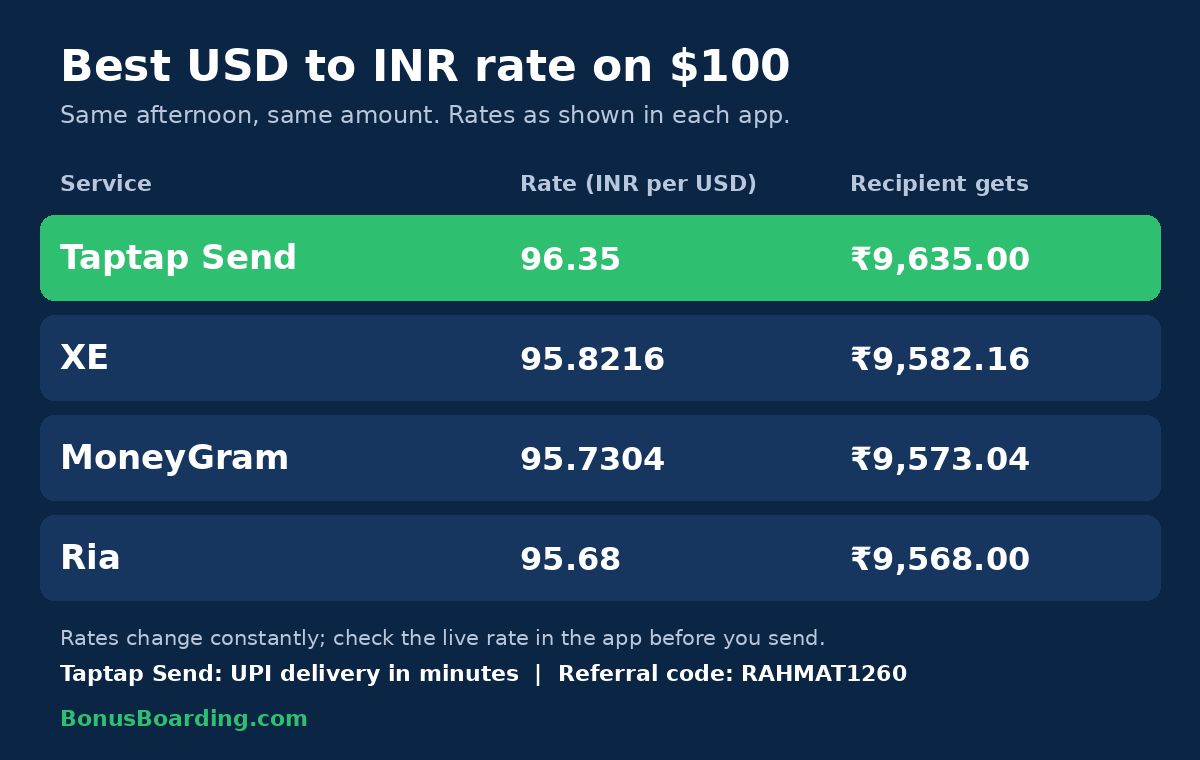
Taptap Send Review: Best USD to INR Rate Compared
What Taptap Send is, how US-to-India transfers work, and how its USD to INR rate compared with XE, MoneyGram and Ria on the same afternoon.

Join the discussion
Share your take, ask a question, or swap tips with other readers. Be kind — we moderate.