How to Start Earning Card Rewards With No US Credit
If you’re brand new to US credit, I’d stop thinking about “travel hacking” for a minute and focus on one boring goal: get a no-annual-fee card you can keep forever, use lightly, and pay on time every single month. The rewards matter, sure. But the real win is building a clean credit file so better cards, apartments, car loans, and insurance pricing become easier later.
That’s especially true if you’re on an H-1B, L-1, F-1, green card path, or recently moved to the US. You may have income, savings, and a great financial history overseas, but US lenders often see a blank file. Annoying? Absolutely. Fixable? Yes — if you sequence your first cards correctly.
The beginner mistake: chasing points before building credit
The cards people brag about online are usually not the right first cards. Premium travel cards, giant welcome bonuses, airport lounge access, hotel certificates — those are nice once you already have established credit. If you apply too early, you risk denials, hard inquiries, and wasted time.
For a beginner, “points basics” starts with credit basics. A credit card is both a payment tool and a credit-building tool. The issuer reports your behavior to the credit bureaus. Over time, on-time payments and low balances help build the track record that makes future approvals easier.
The two habits that matter most are simple: pay on time, and keep utilization low. Utilization is the percentage of your credit limit you’re using. A common beginner target is under 30%. So if your first card has a $200 limit, try not to let more than $60 report on the statement. You can still spend more during the month if needed, but pay it down before the statement closes.
That one detail trips up a lot of newcomers. Paying by the due date avoids interest and late fees, but the statement balance is often what gets reported. If you have a tiny limit, you may need to make extra mid-cycle payments.
What counts as a good first rewards card?
In my view, the best first card has five traits: $0 annual fee, realistic approval odds, reports to the credit bureaus, a path to grow with you, and rewards that don’t tempt you to overspend.
Cash back is usually better than airline miles at this stage. Airline miles are fun, but they’re harder to value, easier to waste, and less useful if you’re still learning US credit. Cash back is clean. If you earn $50, you earned $50. No award charts, no blackout anxiety, no transfer-partner homework.
Secured cards are often the most practical starting point. A secured credit card generally requires a refundable security deposit that serves as the credit limit. That deposit reduces the bank’s risk, which can make secured cards accessible when you have no or limited US credit history.
The trade-off is obvious: your money is tied up. If you put down a $200 deposit, that cash isn’t available for rent, groceries, or emergencies. So I don’t love huge deposits unless you can truly spare the cash. But a modest deposit can be a smart toll to enter the US credit system.
Best first-card paths for newcomers and credit beginners
If you have a Social Security Number, your path is cleaner. You can apply like any other beginner, though your short credit history still matters. If you don’t have an SSN, look into whether you can get an Individual Taxpayer Identification Number, or ITIN. American Express says some individuals can apply for credit cards using an ITIN instead of an SSN, which can be useful for people who aren’t eligible for an SSN yet.
I wouldn’t assume every issuer handles ITIN applications the same way. They don’t. Some online applications are built around SSNs, some allow ITINs, and some may require extra identity verification. Before applying, check the issuer’s current application requirements directly.
For F-1 students, student cards can be attractive if you qualify. The Discover it® Student Cash Back card has a $0 annual fee and earns 5% cash back on everyday purchases at different places each quarter — categories like Amazon.com, grocery stores, restaurants, and gas stations — up to the quarterly maximum after activation. Discover also offers an automatic Cashback Match at the end of the first year, and the card includes a $20 statement credit each school year your GPA is 3.0 or higher for up to the next 5 years.
That’s a genuinely strong student setup, but only if you’re eligible and can handle activation categories. If rotating categories sound like homework, don’t force it. The best rewards card is the one you’ll use correctly.
Three secured cards beginners should compare
The Discover it® Secured Credit Card is the most rewards-friendly secured card in this group. It has a $0 annual fee, earns 2% cash back at gas stations and restaurants on up to $1,000 in combined purchases each quarter, and earns 1% cash back on everything else. New cardmembers also get Cashback Match, where Discover automatically matches all cash back earned at the end of the first year.
That first-year match is the reason I like it for beginners who spend meaningfully on food and gas. You’re not getting airline miles, but you’re getting simple value while building credit.
The Capital One Platinum Secured Credit Card is more of a credit-building tool than a rewards play. It has a $0 annual fee and requires a security deposit of $49, $99, or $200, which typically secures an initial $200 credit line, depending on creditworthiness. Capital One also says cardholders are automatically considered for a credit limit increase in as little as 6 months with responsible use.
That lower possible deposit is the appeal. If Capital One only requires $49 or $99 from you for a $200 line, that’s easier on cash flow than tying up the full amount. The downside is that the research brief doesn’t list rewards for this card, so I wouldn’t choose it if your main goal is cash back. I’d choose it if approval access and a smaller deposit matter more.
The Bank of America® Customized Cash Rewards Secured Credit Card is interesting because it offers more control. It has a $0 annual fee and earns 3% cash back in a category of your choice, 2% at grocery stores and wholesale clubs, and 1% on everything else. The 3% and 2% rates apply on the first $2,500 in combined choice category, grocery store, and wholesale club purchases each quarter.
That cap is generous enough for many beginners, but the card is less “set it and forget it” than a flat card. It works best if your spending lines up with the choice category and you’re willing to pay attention to the quarterly cap.
Worked example: Discover secured vs. Bank of America secured
Let’s say you’re a new H-1B worker and your first-card spending is modest: $250 per month at restaurants, $100 per month on gas, $300 per month on groceries, and $200 per month on everything else. That’s $850 per month, or $10,200 per year.
On the Discover it® Secured Credit Card, restaurants plus gas are $350 per month, or $1,050 per quarter. Since the 2% category is capped at $1,000 in combined purchases each quarter, you’d earn 2% on $1,000 per quarter and 1% on the remaining $50 per quarter. Over a year, that’s $80 from the capped 2% spending, $2 from the overflow, and $60 from groceries plus other 1% spending. Total before the first-year Cashback Match: $142. With the automatic first-year match, that becomes $284 in first-year cash back.
That’s excellent for a secured card.
Now compare the Bank of America® Customized Cash Rewards Secured Credit Card. Suppose you choose restaurants as your 3% category. Your restaurants are $250 per month, or $3,000 per year, earning $90. Groceries are $300 per month, or $3,600 per year, earning 2%, or $72, assuming you stay within the quarterly combined cap. Gas and everything else at 1% would add $36. Total: $198 for the year.
In that specific example, Discover wins in year one because Cashback Match pushes the total higher. Without that match, Bank of America could win for someone whose spending fits the 3% category well. That’s the kind of math you should do before applying. Don’t pick a card because it sounds popular; pick it because your spending makes sense.
The first 12 months: how I’d sequence it
Month one is about getting approved and avoiding mistakes. Pick one starter card. Not three. New credit beginners sometimes spray applications everywhere because one denial feels personal. Don’t do that. Each application may create a hard inquiry, and multiple recent inquiries can make you look riskier.
Once approved, put a few predictable expenses on the card: phone bill, groceries, transit, maybe one restaurant charge. Then set autopay. I prefer autopay for the full statement balance, not the minimum. Paying only the minimum is how rewards become irrelevant fast, because interest can wipe out any cash back you earned.
For a tiny credit line, watch utilization. If your limit is $200 and you spend $180, that’s 90% utilization even if you plan to pay it off. A cleaner approach is to spend $50, pay it down, then spend again if needed. This is annoying, but temporary.
Around six months, you can reassess. Capital One says Platinum Secured cardholders are automatically considered for a credit limit increase in as little as 6 months with responsible use. Other issuers may have their own review processes, so check directly. The goal is either a higher limit, graduation to an unsecured card, or enough history to qualify for a better second card.
I’d usually wait at least six to twelve months before applying for a more ambitious rewards card, unless your profile improves quickly through income, banking relationship, or a credit file that starts reporting cleanly.
Common newcomer problems that can derail approvals
Identity verification is a bigger issue for newcomers than people realize. If your name format differs across documents, your address is temporary, or you recently moved, an issuer may have trouble verifying you. Use consistent information. Keep your bank account, lease, phone bill, and card applications aligned as much as possible.
Income can also be confusing. You generally want to report income you can reasonably access and verify if asked. Don’t inflate it. Issuers can request documentation, and getting cute here is not worth it.
Another mistake: closing your first no-fee card too soon. If it has no annual fee and no major downside, keeping it open can help your average account age over time. You don’t need to use it heavily forever. A small recurring charge, paid in full, can keep it active.
And please don’t carry a balance “to build credit.” That myth refuses to die. You build credit by using the card responsibly and paying as agreed. Carrying interest-bearing debt is just expensive.
Frequently asked questions
Can I get a US credit card without an SSN?
Sometimes, yes. American Express says some individuals can apply with an ITIN instead of an SSN. Other issuers vary, and application rules can change, so check the current issuer page before applying. If you don’t have an SSN or ITIN, your options may be more limited, and you may need to start through a bank relationship, student option, or secured product that can verify your identity another way.
Is a secured card bad compared with a regular credit card?
No. A secured card is just a starting tool. The deposit is the annoying part, but the right secured card can still earn rewards and build credit history. I’d rather have a $0 annual fee secured card used perfectly for a year than a flashier unsecured card that tempts you into debt.
How much should I spend on my first card?
Less than your limit allows. If your limit is $200, try to keep the reported balance under $60 to stay below 30% utilization. You can make extra payments during the month if needed. The habit matters more than the volume of spending.
Should I choose points or cash back first?
Cash back first, in most cases. Points become powerful once you qualify for stronger travel cards and understand transfer partners. At the beginning, simple cash back plus clean credit history is the better foundation.
Bottom line
Your first US rewards card shouldn’t be fancy. It should be approved, free to keep, easy to manage, and useful for building a clean credit file.
For many beginners, I’d look hardest at the Discover it® Secured Credit Card if the goal is first-year rewards, especially because of Cashback Match. I’d consider the Capital One Platinum Secured Credit Card if a smaller possible deposit is the priority. I’d consider the Bank of America® Customized Cash Rewards Secured Credit Card if you want a stronger category setup and can use the 3% choice category well.
For students, the Discover it® Student Cash Back card can be a strong $0 annual fee option if you qualify and don’t mind activating rotating categories.
The real strategy is boring but powerful: get one card, pay in full, keep utilization low, avoid unnecessary applications, and let time do its work. Do that for six to twelve months, and you’ll be in a much better position to chase the bigger points and miles opportunities later.
Keep reading
- Points 101
Chase Ultimate Rewards vs. Amex Membership Rewards: Which Is Better?
The two most powerful credit card points currencies compared — transfer partners, earn rates, and which to choose.
- Points 101
Transferable points 101: why flexible currencies beat airline miles
Chase, Amex, Capital One, and Citi points all transfer to airline partners. Here's how the system works and why it's the right default.
- Credit for Immigrants
Taptap Send Review: Best USD to INR Rate Compared
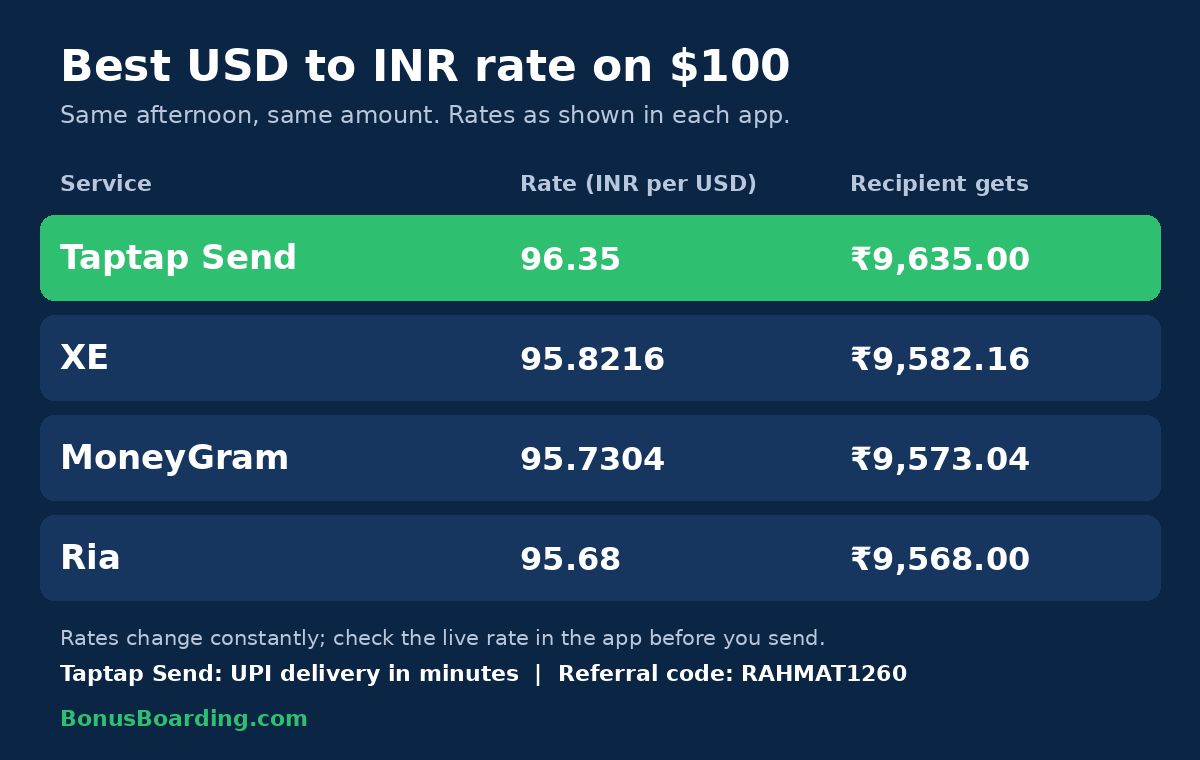
What Taptap Send is, how US-to-India transfers work, and how its USD to INR rate compared with XE, MoneyGram and Ria on the same afternoon.


Join the discussion
Share your take, ask a question, or swap tips with other readers. Be kind — we moderate.